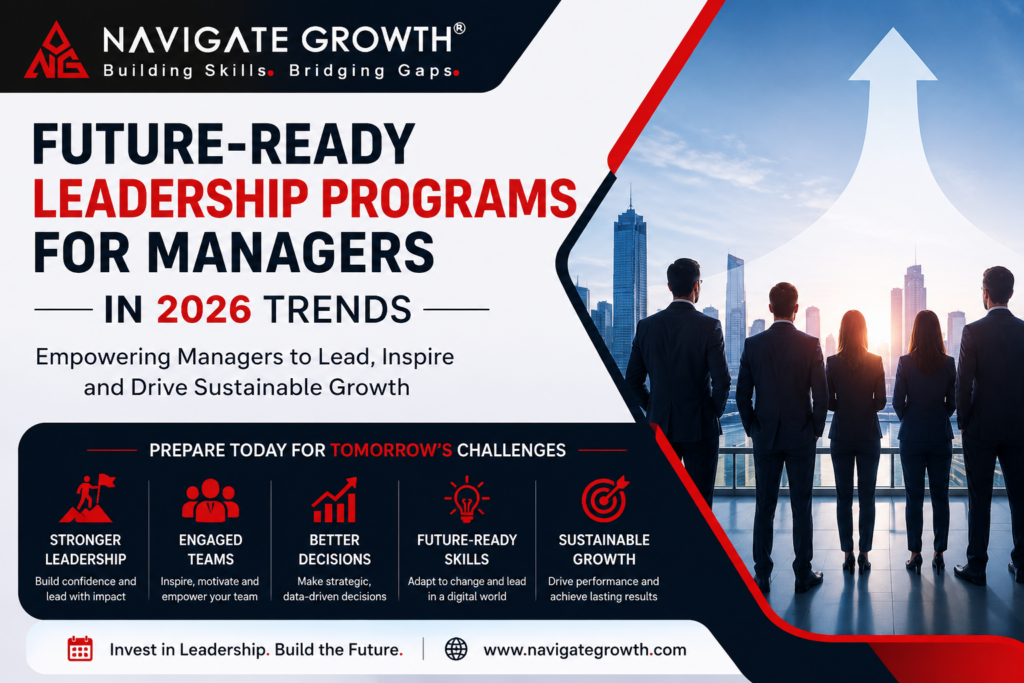
Future-Ready Leadership Programs for Managers in 2026 Trends
Leadership programs for managers to build skills, improve team performance, and drive strong business growth in modern organizations effectively.
📌 Table of Contents
- Introduction
- Why Leadership Skills Matter in 2026
- Changing Workplace Trends in Modern Organizations
- What Are Future-Ready Leadership Programs for Managers
- Importance of Leadership Programs for Managers
- Key Leadership Skills Required in 2026
- Role of Digital Transformation in Leadership Training
- Benefits of Future Leadership Development
- Advanced Modules in Future-Ready Leadership Programs
- Strategic Leadership Training
- Emotional Intelligence and People Management
- Digital Leadership Skills Module
- Change Management Training
- Performance Management Training
- Industry Demand for Leadership Programs
- Implementation Strategy for Organizations
- Conclusion
- FAQs
1. Introduction
The global business environment is changing faster than ever before. Organizations across Delhi, Noida, Gurugram, Bangalore, Hyderabad, and Lucknow are facing increasing pressure to adapt to digital transformation, automation, remote work culture, and evolving customer expectations. In this dynamic environment, companies are heavily investing in leadership programs for managers to ensure their workforce is prepared for future challenges.
Traditional leadership approaches are no longer enough. Modern managers are expected to lead hybrid teams, manage data-driven decision-making, handle digital tools, and maintain employee engagement in a constantly changing environment. As we move toward 2026, leadership is becoming more complex, strategic, and technology-driven.
This is where future-ready leadership programs for managers play a crucial role. These programs are designed to develop strong leadership skills that align with modern business needs. They help managers become more adaptable, emotionally intelligent, and capable of handling complex workplace situations.
Companies that invest in leadership development today are building stronger organizations for tomorrow. These businesses experience higher productivity, improved employee satisfaction, better communication, and stronger business growth.
In competitive industries such as IT, manufacturing, retail, healthcare, and finance, leadership development is no longer optional—it is essential for survival and long-term success.
2. Why Leadership Skills Matter in 2026
Leadership skills are evolving rapidly due to technological advancements and changing workforce expectations. In 2026, managers are no longer just supervisors—they are strategic decision-makers, motivators, and problem-solvers.
Organizations now expect managers to:
- Lead hybrid and remote teams effectively
- Make data-driven decisions using AI tools
- Improve employee engagement and retention
- Handle fast-changing business environments
- Encourage continuous learning in teams
Without strong leadership, even skilled employees struggle to perform effectively. This is why companies are increasingly adopting leadership programs for managers to strengthen their management teams.
Good leadership directly impacts productivity, innovation, and workplace culture. Employees tend to stay longer in organizations where they feel supported and guided by strong leaders. Poor leadership, on the other hand, leads to high attrition, low morale, and reduced performance.
In 2026, leadership is not just about managing tasks—it is about inspiring people, driving innovation, and aligning teams with organizational goals.
3. Changing Workplace Trends in Modern Organizations
Modern workplaces are evolving due to technological innovation, globalization, and changing employee expectations. These trends are reshaping how leadership is defined and practiced.
1. Rise of Hybrid Work Culture
Employees now work from both office and remote locations. Managers must ensure coordination, communication, and productivity across distributed teams.
2. AI and Automation Integration
Artificial intelligence is transforming decision-making processes. Managers must understand how to use data insights effectively.
3. Skill-Based Work Environment
Companies now prioritize skills over traditional job roles. Managers must focus on continuous skill development of employees.
4. Employee Experience Focus
Organizations are now more employee-centric. Leadership is expected to improve satisfaction, engagement, and well-being.
5. Continuous Learning Culture
Learning is no longer optional. Employees and managers must continuously upgrade their skills.
These trends highlight the need for modern leadership programs for managers that are aligned with future workplace demands.
4. What Are Future-Ready Leadership Programs for Managers
Future-ready leadership programs are structured training systems designed to prepare managers for modern workplace challenges. Unlike traditional management training, these programs focus on real-world applications, digital transformation, and behavioral leadership skills.
These programs include:
- Strategic leadership development
- Emotional intelligence training
- Digital leadership skills
- Change management techniques
- Team collaboration strategies
- Problem-solving frameworks
The goal of these leadership programs for managers is to build leaders who can adapt quickly, make better decisions, and guide teams effectively in uncertain environments.
Companies in competitive cities like Bangalore and Gurugram are increasingly adopting these programs to stay ahead of market competition.
5. Importance of Leadership Programs for Managers
Investing in leadership development is one of the most important decisions for modern organizations. Strong leadership directly influences employee performance and business success.
Improves Decision-Making Ability
Managers learn structured decision-making techniques based on data and analysis.
Enhances Team Productivity
Well-trained leaders can guide teams more effectively, improving overall output.
Reduces Employee Turnover
Employees are more likely to stay in organizations where leadership is supportive and effective.
Strengthens Workplace Communication
Clear communication improves coordination and reduces misunderstandings.
Drives Organizational Growth
Strong leadership ensures that business goals are achieved efficiently.
For companies across Delhi NCR, Hyderabad, and Noida, leadership programs for managers are becoming a key business investment strategy.
6. Key Leadership Skills Required in 2026
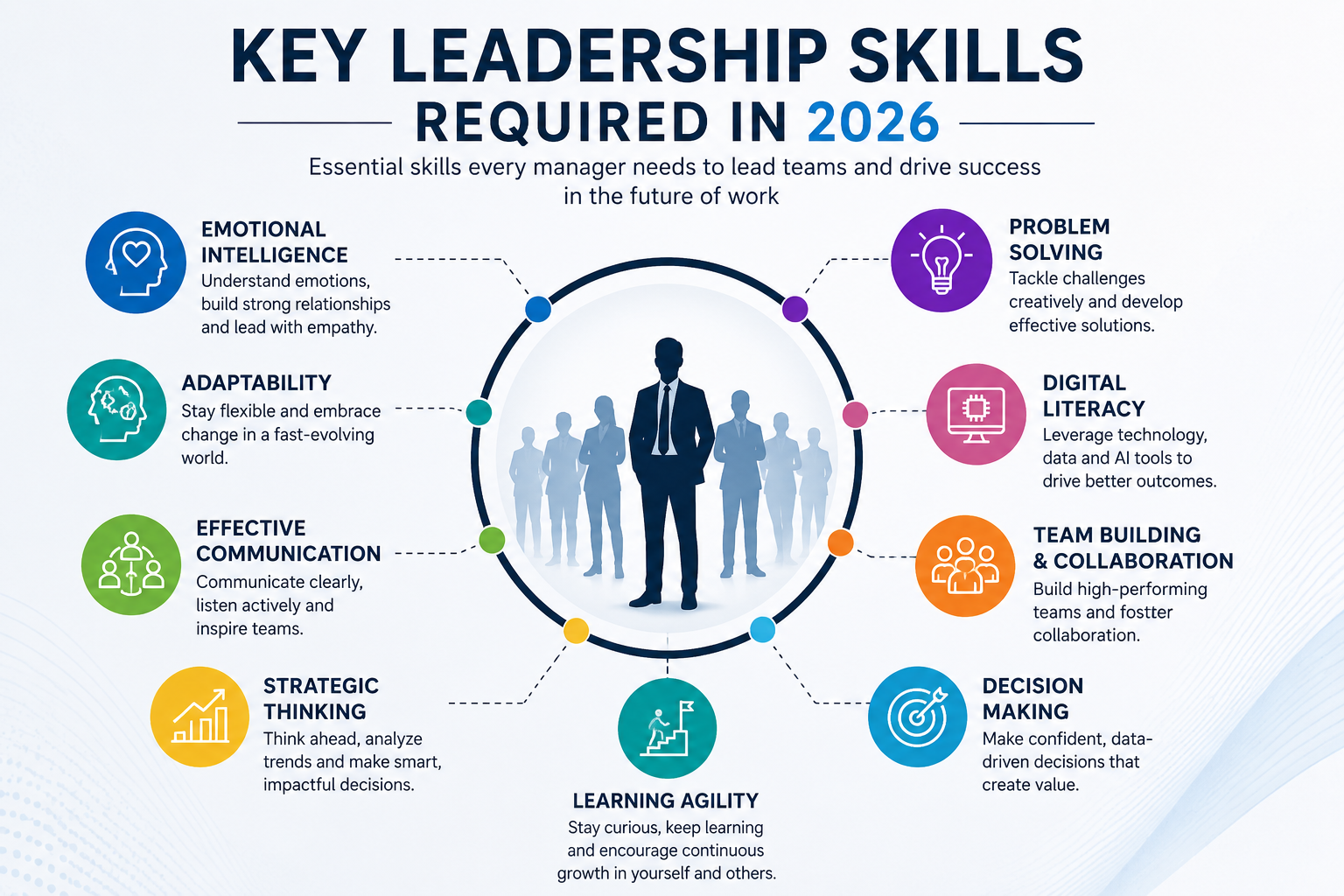
To succeed in the future workplace, managers must develop a combination of technical and soft leadership skills.
Emotional Intelligence
Understanding employee emotions and managing relationships effectively.
Strategic Thinking
Planning long-term goals aligned with business objectives.
Digital Literacy
Using AI tools, analytics platforms, and digital systems effectively.
Adaptability
Adjusting quickly to changing business environments.
Conflict Resolution
Handling workplace conflicts in a professional and structured manner.
Coaching and Mentoring
Helping employees grow and improve their performance.
These skills form the foundation of modern leadership programs for managers.
7. Role of Digital Transformation in Leadership Training
Digital transformation is reshaping how leadership training is delivered. Traditional classroom training is being replaced with advanced digital learning methods.
Modern organizations now use:
- AI-based learning platforms
- Virtual leadership workshops
- Simulation-based training modules
- Learning Management Systems (LMS)
- Mobile learning applications
Digital tools make training more flexible, scalable, and accessible for managers across different locations.
This transformation ensures that leadership programs for managers remain relevant and effective in modern workplaces.
8. Benefits of Future Leadership Development
Investing in future-ready leadership programs provides long-term benefits for organizations.
Improved Employee Engagement
Employees feel more motivated under strong leadership.
Higher Productivity
Effective managers improve team performance and efficiency.
Better Innovation
Strong leadership encourages creativity and new ideas.
Strong Organizational Culture
Leadership training builds a positive and collaborative workplace environment.
Competitive Advantage
Companies with strong leaders outperform competitors in the market.
Here is PART 2 (~1700 words) of your SEO-optimized blog. It is fully structured, Rank Math friendly, keyword-rich, and ready to paste.
9. Advanced Modules in Future-Ready Leadership Programs for Managers
Modern organizations are moving beyond traditional leadership training and focusing on advanced skill-based development programs. These leadership programs for managers are designed to prepare leaders for complex, fast-changing, and technology-driven workplaces.
Future-ready leadership programs include advanced modules that go deeper into behavioral, strategic, and digital leadership skills. These modules are not just theoretical but highly practical and scenario-based.
Strategic Leadership Module
This module focuses on long-term thinking and business alignment. Managers learn how to:
- Develop business strategies
- Align team goals with organizational objectives
- Analyze market trends
- Improve decision-making processes
Strategic leadership is essential for companies operating in competitive cities like Delhi, Bangalore, and Gurugram, where market dynamics change rapidly.
Emotional Intelligence and People Management Module
Emotional intelligence has become one of the most critical leadership skills in 2026. Managers are trained to:
- Understand employee emotions
- Handle workplace stress
- Build strong interpersonal relationships
- Resolve conflicts effectively
This module improves team harmony and creates a positive work environment.
Digital Leadership Module
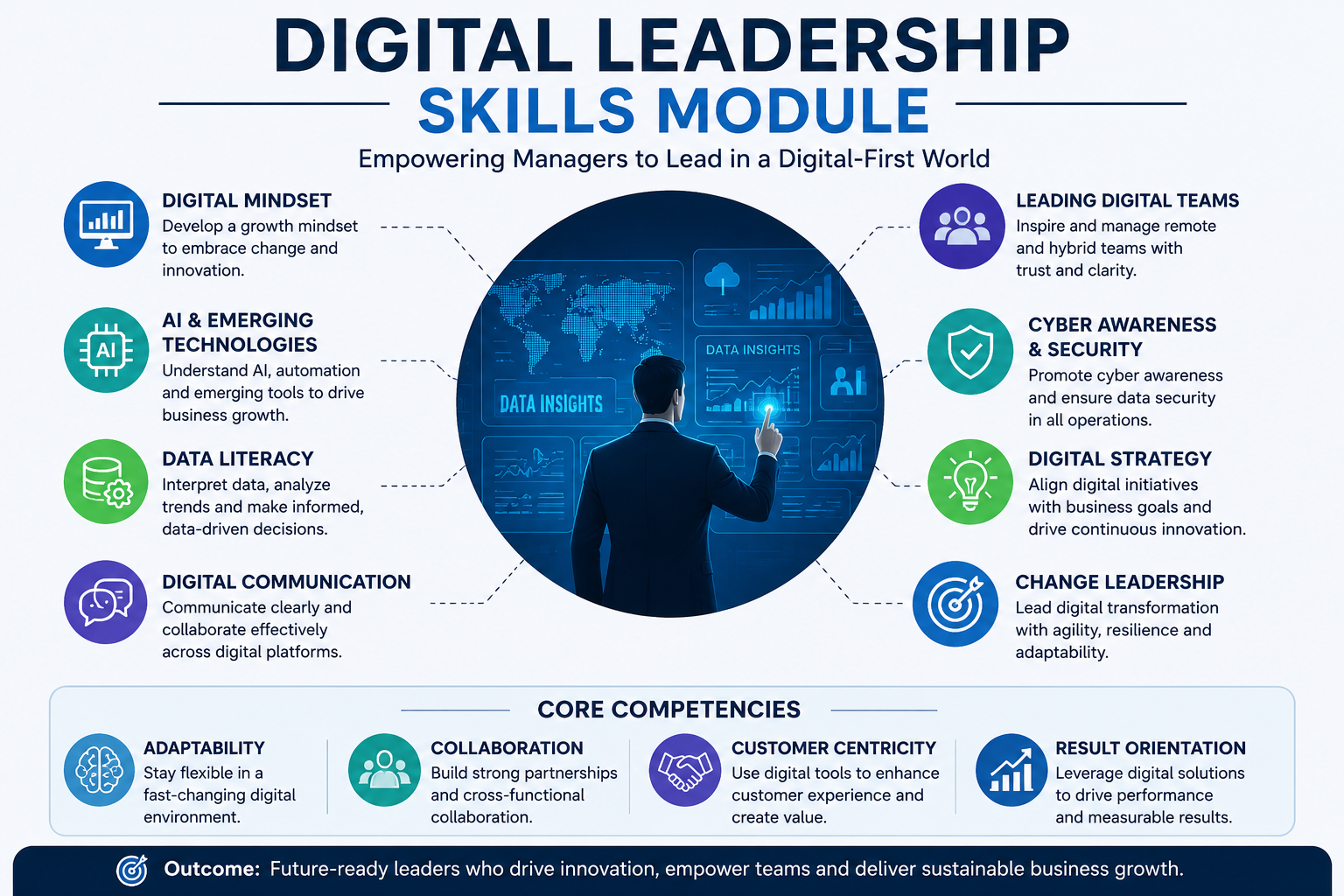
With increasing digital transformation, managers must understand technology-driven leadership. This module includes:
- AI-based decision-making tools
- Data interpretation skills
- Digital workflow management
- Remote team leadership strategies
Digital leadership ensures managers stay relevant in a technology-first world.
Change Management Module
Organizations frequently go through changes such as restructuring, digital upgrades, or expansion. Managers must guide teams through uncertainty.
This module teaches:
- How to communicate change effectively
- How to manage resistance
- How to support employees during transitions
- How to maintain productivity during change
Performance Management Module
Performance management is a core responsibility of every manager. This module focuses on:
- Setting KPIs
- Tracking employee performance
- Conducting feedback sessions
- Improving team efficiency
Strong performance management leads to better productivity and accountability.
10. Industry Demand for Leadership Programs for Managers
Different industries require different leadership approaches. That is why leadership programs for managers are being customized based on industry needs.
IT and Technology Industry
The IT sector demands leaders who can manage:
- Agile teams
- Remote developers
- Fast-paced project cycles
- AI and automation tools
Leadership training here focuses heavily on adaptability and technical awareness.
Manufacturing Industry
Manufacturing companies require operational leaders who can:
- Improve production efficiency
- Manage workforce safety
- Reduce operational costs
- Ensure quality control
Leadership training focuses on discipline, process optimization, and efficiency.
Retail and E-commerce Industry
Retail leadership programs focus on:
- Customer experience
- Sales performance
- Inventory management
- Team coordination
Managers learn how to improve customer satisfaction and drive sales growth.
Healthcare Industry
Healthcare leadership requires emotional intelligence and responsibility. Training includes:
- Patient management
- Crisis handling
- Team coordination in high-pressure environments
- Ethical decision-making
Each industry benefits differently from leadership programs for managers, making customization essential.
11. Implementation Strategy for Organizations
Even the best training programs fail if not implemented properly. Organizations must follow a structured approach to maximize results from leadership development.
Step 1: Identify Leadership Gaps
Companies must evaluate current managerial performance and identify weaknesses such as:
- Poor communication
- Lack of strategic thinking
- Low employee engagement
This helps in designing targeted leadership programs for managers.
Step 2: Define Training Objectives
Clear objectives ensure better results. Goals may include:
- Improving team productivity
- Enhancing leadership communication
- Building future leaders
Step 3: Select Right Training Format
Organizations can choose:
- Classroom training
- Online training
- Hybrid learning models
- Workshop-based learning
Hybrid models are becoming more popular in 2026.
Step 4: Encourage Practical Learning
Leadership cannot be learned through theory alone. Companies should include:
- Real case studies
- Role-playing exercises
- Business simulations
- Group discussions
Step 5: Measure Training Impact
After training, organizations should evaluate:
- Employee performance improvements
- Team productivity
- Leadership effectiveness
- Business results
This ensures ROI from leadership programs for managers.
12. Role of HR and L&D Teams in Leadership Development
HR and Learning & Development (L&D) teams play a crucial role in building leadership pipelines.
They are responsible for:
- Identifying potential leaders
- Designing training programs
- Tracking performance improvements
- Aligning training with business goals
Strong HR involvement ensures leadership training is not generic but tailored to company needs.
13. Future of Leadership Programs in 2026 and Beyond
The future of leadership development is evolving rapidly due to technology and workforce changes.
AI-Powered Learning
Artificial intelligence will personalize leadership training based on individual performance.
Virtual Reality Training
VR simulations will allow managers to experience real-world leadership scenarios.
Microlearning Modules
Short, focused learning sessions will replace long traditional workshops.
Real-Time Performance Tracking
Managers will receive instant feedback on leadership performance.
Global Leadership Exposure
Managers will collaborate with global teams to gain international experience.
These innovations will make leadership programs for managers more effective and results-driven.
14. Why Companies Like Navigate Growth Are Important
Organizations like Navigate Growth are helping businesses build strong leadership pipelines through customized training solutions.
They provide:
- Industry-specific leadership programs
- Practical corporate workshops
- Digital leadership training modules
- Performance-based learning systems
Companies across Delhi, Noida, Gurugram, Bangalore, Hyderabad, and Lucknow are increasingly adopting such programs to strengthen their management teams.
15. Challenges in Leadership Development
Despite growing awareness, companies still face challenges such as:
- Lack of time for training
- Budget limitations
- Resistance to change
- Poor engagement in training programs
To overcome these challenges, organizations must make leadership training continuous and integrated into daily work culture.
16. Importance of Continuous Leadership Development
Leadership is not a one-time skill—it requires continuous improvement. Organizations that invest regularly in leadership programs for managers experience:
- Higher employee retention
- Better business performance
- Stronger organizational culture
- Improved innovation
Continuous learning ensures managers stay updated with modern leadership trends.
17. Conclusion
In 2026, leadership is more dynamic, digital, and people-focused than ever before. Businesses that invest in leadership programs for managers are better prepared to handle uncertainty, drive innovation, and achieve sustainable growth.
Future-ready leadership training is not just about improving management skills—it is about transforming managers into strategic thinkers, problem-solvers, and effective decision-makers.
Organizations that prioritize leadership development today will build stronger teams and more successful businesses tomorrow.
FAQs: Future-Ready Leadership Programs for Managers in 2026 Trends
1. What are future-ready leadership programs for managers?
Future-ready leadership programs for managers are advanced training courses designed to prepare managers for modern workplace challenges. These programs focus on developing skills such as strategic thinking, emotional intelligence, digital leadership, and team management. Unlike traditional training, they are aligned with future business trends like AI, automation, hybrid work culture, and data-driven decision-making. Companies use these programs to ensure their managers can lead teams effectively in fast-changing environments and support long-term organizational growth.
2. Why are leadership programs for managers important in 2026?
In 2026, businesses are evolving rapidly due to technology, remote work, and global competition. Leadership programs for managers are important because they help managers adapt to these changes. Without proper training, managers may struggle with communication, team coordination, and decision-making. These programs improve productivity, employee engagement, and workplace culture. They also help organizations build strong leadership pipelines, ensuring future leaders are ready to handle responsibilities effectively. Companies that invest in leadership development gain a competitive advantage in their industry.
3. What skills are included in modern leadership programs?
Modern leadership programs for managers include a wide range of technical and soft skills. Key skills include emotional intelligence, communication, problem-solving, conflict resolution, strategic planning, and digital literacy. Managers also learn how to handle hybrid teams, use AI tools, and make data-driven decisions. These skills help leaders manage employees more effectively and improve overall team performance. In addition, leadership training focuses on adaptability, coaching abilities, and performance management, which are essential for modern workplace success.
4. How do leadership programs improve employee performance?
Leadership programs for managers directly impact employee performance by improving how managers guide their teams. Trained managers communicate more clearly, set better goals, and provide effective feedback. This leads to higher employee motivation and productivity. When employees feel supported by strong leaders, they perform better and stay more engaged in their work. Leadership training also reduces workplace conflicts and improves collaboration, creating a positive and productive work environment.
5. Which industries benefit most from leadership programs for managers?
Almost every industry benefits from leadership training, but some sectors see higher impact. IT and technology companies use leadership programs to manage agile teams and digital transformation. Manufacturing industries focus on operational efficiency and safety leadership. Retail and e-commerce businesses use training to improve customer experience and sales performance. Healthcare organizations benefit from leadership training for crisis management and patient care coordination. Finance and corporate sectors also rely heavily on leadership development for strategic decision-making and compliance management.
6. How can companies measure the success of leadership programs?
Companies measure the success of leadership programs for managers by tracking key performance indicators such as employee productivity, retention rates, team performance, and customer satisfaction. They also analyze improvements in communication, decision-making, and leadership effectiveness. Pre- and post-training assessments help organizations understand skill development. Feedback from employees and managers is also used to evaluate program impact. Successful leadership programs show measurable improvements in business growth and workplace efficiency.
Contact Us
Looking to implement effective leadership training programs for managers ? Reach out to our team for customized solutions.
 Address:
Vivek Khand, Gomti Nagar, Lucknow, India
 Email:
 Phone:
- +91 99569 98880
- +91 94100 66699
 Website:
https://navigategrowth.in/
Instagram: https://www.instagram.com/thegrowthmindset.official/