Introduction
In today’s competitive business environment, organizations are investing more in employee training and development programs than ever before. Rapid technological advancements, changing customer expectations, artificial intelligence, automation, and evolving workplace dynamics have made continuous learning essential for every business. Companies that prioritize employee development not only improve workforce performance but also create a culture of innovation, collaboration, and long-term success.
Modern organizations understand that hiring talented employees is only the first step. To maintain a competitive advantage, businesses must continuously enhance their employees’ knowledge, technical expertise, leadership capabilities, and interpersonal skills. This is where employee training and development programs play a vital role. These programs help employees adapt to industry changes, improve productivity, and prepare for future leadership roles.
According to various workplace studies, organizations that invest in structured learning initiatives experience higher employee engagement, better retention rates, increased productivity, and stronger customer satisfaction. Employees also value companies that invest in their professional growth, making training an important factor in attracting and retaining top talent.
Whether you’re a startup, SME, or multinational corporation, implementing advanced learning strategies can significantly improve business performance. From leadership development and technical training to communication workshops and digital learning platforms, organizations now have numerous options to upskill their workforce effectively.
This guide explores the importance of employee training and development programs, their benefits, and how businesses can select the right training strategies before implementing advanced learning initiatives.
1. What Are Employee Training and Development Programs?
Employee training and development programs are structured learning initiatives designed to improve employees’ knowledge, skills, competencies, and overall job performance. While training focuses on enhancing employees’ abilities for their current roles, development prepares them for future responsibilities, leadership positions, and career advancement.
These programs help employees stay updated with industry trends, emerging technologies, organizational processes, and best practices. They also support businesses by creating a skilled workforce capable of adapting to changing market conditions.
Organizations deliver training through various methods, including:
- Classroom sessions
- Online learning platforms
- Instructor-led workshops
- On-the-job training
- Mentorship programs
- Coaching sessions
- Simulation-based learning
- Microlearning modules
A successful learning strategy combines technical knowledge with soft skills such as leadership, communication, emotional intelligence, teamwork, and problem-solving.
Training vs Development
| Training | Development |
|---|---|
| Focuses on current job performance | Focuses on future career growth |
| Short-term objective | Long-term objective |
| Skill-specific learning | Leadership and personal growth |
| Improves existing capabilities | Builds future competencies |
| Immediate performance improvement | Career advancement |
Although different, training and development complement each other and together contribute to organizational success.
2. Why Employee Training and Development Programs Matter in 2026
The workplace has transformed dramatically over the last few years. Digital transformation, artificial intelligence, remote work, cybersecurity challenges, and automation have created new skill requirements across industries.
Organizations that fail to invest in learning often struggle with reduced productivity, higher turnover, lower employee engagement, and difficulty adapting to market changes.
1 Rapid Technological Advancements
Technology evolves quickly, making many existing skills outdated within a few years. Employees need continuous learning to remain effective in their roles.
Training areas include:
- Artificial Intelligence
- Cloud Computing
- Data Analytics
- Cybersecurity
- Automation Tools
- Digital Collaboration Platforms
Upskilling ensures employees remain productive while helping organizations maximize their technology investments.
2 Higher Employee Expectations
Today’s employees expect employers to invest in their professional development.
Employees increasingly seek:
- Career progression
- Leadership opportunities
- Professional certifications
- Personalized learning
- Flexible training formats
Organizations offering continuous development often enjoy stronger employee loyalty and improved retention.
3 Increased Productivity
Employees who understand their responsibilities and possess updated skills complete tasks more efficiently.
Training helps employees:
- Reduce mistakes
- Improve decision-making
- Increase efficiency
- Deliver higher-quality work
- Solve problems faster
Better-trained employees contribute directly to improved organizational performance.
4 Better Employee Retention
Replacing experienced employees is expensive and time-consuming.
When businesses invest in learning opportunities, employees feel valued and are more likely to remain with the organization.
Training demonstrates that the company cares about long-term employee success rather than short-term performance.
5 Stronger Leadership Pipeline
Every organization requires future leaders.
Leadership-focused development prepares high-performing employees for management responsibilities through coaching, mentoring, strategic thinking, and decision-making training.
Instead of hiring external managers, companies can promote capable internal employees.
Business Impact of Employee Development
| Business Challenge | Training Solution | Expected Outcome |
|---|---|---|
| Low productivity | Skill enhancement | Higher efficiency |
| High turnover | Career development | Better retention |
| Leadership gaps | Leadership programs | Strong managers |
| Technology adoption | Digital skills training | Faster implementation |
| Customer complaints | Customer service training | Improved satisfaction |
3. Benefits of Employee Training and Development Programs
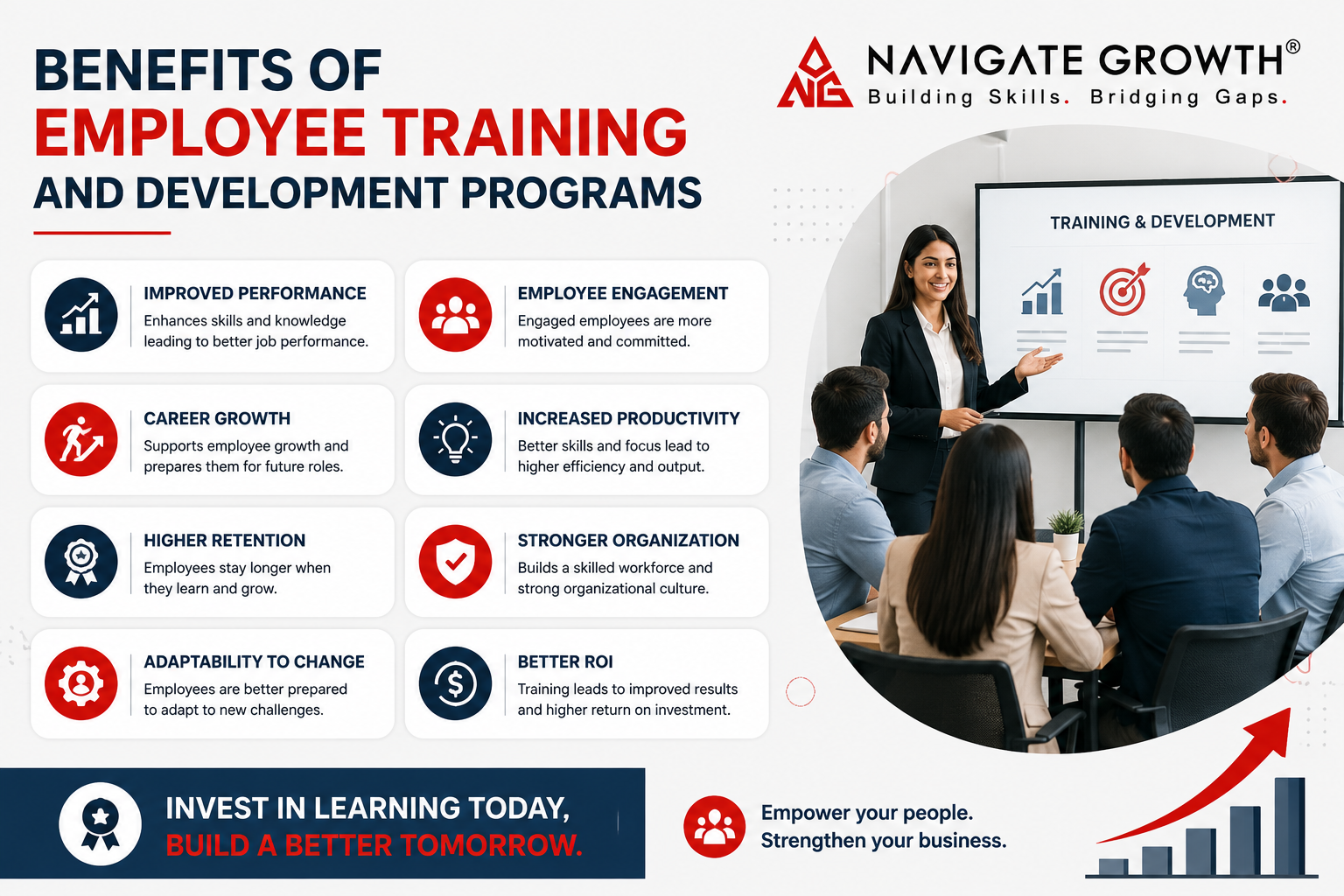
Organizations that consistently invest in employee learning experience measurable improvements across multiple business areas.
1 Improved Employee Performance
Employees become more confident when they understand their roles clearly and possess the necessary skills.
Improved performance leads to:
- Better quality work
- Faster execution
- Increased accountability
- Greater confidence
- Reduced supervision
2 Higher Employee Engagement
Learning opportunities create excitement and motivation.
Employees appreciate organizations that support continuous growth.
Engaged employees generally:
- Participate actively
- Take initiative
- Share innovative ideas
- Collaborate effectively
- Contribute beyond expectations
3 Better Employee Retention
Career growth remains one of the biggest reasons employees stay with an organization.
Businesses providing regular learning opportunities often experience lower recruitment costs and higher employee satisfaction.
4 Enhanced Innovation
Learning exposes employees to:
- New technologies
- Better workflows
- Industry best practices
- Creative problem-solving techniques
This encourages innovation throughout the organization.
5 Strong Organizational Culture
Continuous learning creates a workplace where improvement becomes part of daily operations.
Employees become:
- More collaborative
- More adaptable
- More supportive
- More willing to share knowledge
Such environments encourage long-term organizational success.
6 Better Customer Experience
Employees who receive customer service and communication training interact more professionally with clients.
Benefits include:
- Faster issue resolution
- Improved communication
- Better client relationships
- Higher customer satisfaction
- Stronger brand reputation
7 Increased Profitability
Skilled employees make fewer mistakes, complete work faster, improve customer satisfaction, and contribute to higher revenue.
Training should be viewed as an investment rather than an expense.
Major Benefits at a Glance
| Benefit | Business Impact |
|---|---|
| Improved skills | Higher productivity |
| Better engagement | Stronger motivation |
| Leadership development | Future-ready managers |
| Lower turnover | Reduced hiring costs |
| Better customer service | Increased customer loyalty |
| Continuous learning | Sustainable business growth |
4. How to Choose the Right Employee Training and Development Programs
Selecting the right learning initiative requires careful planning. Not every training program delivers the same value, so organizations should align learning objectives with business goals and employee needs.
1 Identify Skill Gaps
Begin by evaluating current employee competencies.
Methods include:
- Performance reviews
- Employee assessments
- Manager feedback
- Customer feedback
- Skills matrix analysis
Understanding gaps helps prioritize the most impactful training areas.
2 Define Clear Business Objectives
Every training initiative should support measurable organizational goals, such as:
- Increasing sales
- Improving productivity
- Enhancing leadership
- Strengthening compliance
- Boosting customer satisfaction
Clear objectives ensure that learning investments deliver meaningful business outcomes.
3 Choose the Right Learning Method
Different employees learn in different ways. Consider using a blend of learning formats, including:
- Instructor-led workshops
- Virtual classrooms
- Self-paced online courses
- On-the-job coaching
- Mentoring
- Microlearning
- Interactive simulations
A blended approach often leads to better knowledge retention and application.
4 Measure Training Effectiveness
Training should not end after completion. Evaluate its impact using measurable indicators such as:
- Employee performance improvements
- Productivity gains
- Assessment scores
- Employee feedback
- Customer satisfaction metrics
- Return on investment (ROI)
Regular evaluation helps refine future learning initiatives.
5 Build a Culture of Continuous Learning
Organizations achieve lasting success when learning becomes an ongoing process rather than a one-time event. Encourage employees to pursue new skills, share knowledge with colleagues, and participate in regular development opportunities. Leaders should actively support learning by recognizing achievements and providing time and resources for growth.
By embedding continuous learning into everyday work, businesses can stay competitive, adapt to change more effectively, and prepare employees for future challenges.
5. 10 Advanced Employee Training and Development Programs
Modern organizations require learning initiatives that go beyond basic onboarding and compliance training. The following employee training and development programs help employees build future-ready skills, improve performance, and contribute to long-term business success.
1 Leadership Development Programs
Leadership development prepares employees to take on managerial and executive roles. These programs focus on decision-making, strategic thinking, conflict resolution, delegation, and team management. Organizations that invest in leadership training create a strong pipeline of future leaders while improving employee confidence and organizational stability.
2 Digital Skills Training
As businesses continue to adopt digital technologies, employees need up-to-date technical skills. Digital skills training includes cloud computing, AI tools, data analytics, cybersecurity, digital collaboration platforms, and business software. Adding digital learning to employee training and development programs helps organizations remain competitive in a technology-driven marketplace.
3 Communication Skills Training
Effective communication is essential for teamwork, customer relationships, and workplace productivity. This program develops verbal communication, business writing, presentation skills, active listening, and interpersonal communication. Employees who communicate clearly collaborate more effectively and build stronger professional relationships.
4 Project Management Training
Project management training equips employees with the skills to plan, organize, execute, and monitor projects efficiently. Topics include time management, budgeting, risk management, resource allocation, Agile methodologies, and project planning tools. These skills help organizations complete projects on time and within budget.
5 Technical Skills Development
Technical expertise is critical in industries such as IT, manufacturing, healthcare, engineering, and finance. Technical training keeps employees updated with industry standards, software applications, equipment, and emerging technologies. Continuous technical learning improves productivity while reducing operational errors.
6 Sales and Customer Service Training
Employees who interact with customers directly influence business growth. Sales and customer service training focuses on communication, negotiation, product knowledge, relationship building, customer experience, and complaint resolution. Including this module in employee training and development programs helps increase customer satisfaction, loyalty, and revenue.
7 Diversity, Equity, and Inclusion (DEI) Training
A diverse workplace encourages innovation and collaboration. DEI training teaches employees about workplace inclusion, cultural awareness, unconscious bias, respectful communication, and equal opportunities. These programs help organizations create an inclusive work environment where every employee feels valued and respected.
8 Compliance and Cybersecurity Training
Every organization must ensure employees understand legal regulations, workplace policies, and cybersecurity practices. This training covers data privacy, ethical conduct, information security, phishing prevention, and regulatory compliance. Regular compliance education minimizes business risks and protects sensitive organizational data.
9 Emotional Intelligence Training
Emotional intelligence is becoming one of the most valuable workplace skills. This program helps employees develop self-awareness, empathy, emotional control, resilience, and relationship management. Strong emotional intelligence improves teamwork, leadership effectiveness, and workplace collaboration, making it an important component of modern employee training and development programs.
10 Mentorship and Coaching Programs
Mentorship and coaching connect experienced professionals with employees who want to grow their careers. Through regular guidance, feedback, and knowledge sharing, employees gain practical insights, develop confidence, and improve problem-solving abilities. Organizations that encourage mentoring create a culture of continuous learning and accelerate employee development across all levels.
Key Takeaways
| Advanced Program | Primary Benefit |
|---|---|
| Leadership Development | Builds future leaders |
| Digital Skills Training | Supports digital transformation |
| Communication Skills Training | Improves collaboration |
| Project Management Training | Enhances project success |
| Technical Skills Development | Strengthens job-specific expertise |
| Sales & Customer Service | Increases customer satisfaction |
| Diversity, Equity & Inclusion | Creates an inclusive workplace |
| Compliance & Cybersecurity | Reduces legal and security risks |
| Emotional Intelligence | Improves teamwork and leadership |
| Mentorship & Coaching | Accelerates career growth |
These employee training and development programs enable organizations to build a skilled, adaptable, and future-ready workforce capable of meeting evolving business challenges while driving sustainable growth.
6. Best Practices for Implementing Employee Training and Development Programs
Implementing effective learning initiatives requires proper planning, execution, and continuous improvement. Organizations should focus on creating a structured approach that aligns employee learning with business objectives.
A successful employee training and development program should not only provide information but also help employees apply new skills in real workplace situations.
1 Conduct Training Needs Analysis
Before starting any training initiative, organizations should identify existing skill gaps among employees.
Training needs analysis helps businesses understand:
- Which skills employees need to improve
- Which departments require specific training
- What challenges employees face
- Which learning methods will be most effective
This approach ensures that training resources are invested in areas that create maximum impact.
2 Create Personalized Learning Paths
Every employee has different skills, experience levels, and career goals. Personalized learning paths allow organizations to provide relevant training based on individual requirements.
For example:
- New employees may require basic skill development
- Managers may need leadership training
- Technical teams may need advanced technology training
Personalized learning improves engagement and increases the effectiveness of employee training and development programs.
3 Use Blended Learning Methods
Modern organizations should combine multiple learning methods instead of depending on only one approach.
A blended learning strategy may include:
- Classroom training
- Online courses
- Virtual workshops
- Coaching sessions
- Practical assignments
- Peer learning
This flexible approach allows employees to learn according to their schedules and preferences.
4 Encourage Continuous Learning
Employee development should not be limited to annual training sessions. Businesses should create a culture where learning becomes part of everyday work.
Organizations can encourage continuous learning through:
- Regular workshops
- Knowledge-sharing sessions
- Skill assessments
- Internal training platforms
- Career development discussions
Continuous learning helps employees stay prepared for changing workplace requirements.
5 Measure Training Results
Measuring training effectiveness helps organizations understand whether their investment is creating value.
Important performance indicators include:
| Measurement Area | Purpose |
|---|---|
| Employee performance | Tracks skill improvement |
| Productivity levels | Measures work efficiency |
| Employee feedback | Understands training satisfaction |
| Business results | Evaluates overall impact |
| Retention rates | Measures employee loyalty |
Regular evaluation allows companies to improve their future learning strategies.
7. Common Challenges in Employee Training and Development Programs
Although training provides many benefits, organizations may face challenges while implementing learning initiatives.
1 Limited Training Budget
Some companies hesitate to invest in training because of budget limitations. However, employee development should be considered a long-term investment that improves productivity and reduces future hiring costs.
Organizations can overcome budget challenges by using:
- Online learning platforms
- Internal trainers
- Group training sessions
- Digital resources
2 Lack of Employee Participation
Some employees may not actively participate in training due to workload pressure or lack of interest.
To improve participation, companies should:
- Explain the benefits of training
- Provide relevant learning topics
- Recognize employee achievements
- Make learning interactive
3 Difficulty Measuring ROI
Many organizations struggle to measure the direct impact of training.
Businesses should track:
- Performance improvement
- Sales growth
- Productivity changes
- Employee satisfaction
- Skill development progress
Data-driven measurement helps prove the value of employee training and development programs.
4 Resistance to Change
Employees may hesitate to adopt new processes or technologies.
Organizations can reduce resistance by:
- Communicating the purpose of training
- Providing proper support
- Encouraging feedback
- Offering practical examples
A supportive learning environment makes employees more comfortable with change.
8. How to Measure the Success of Employee Training and Development Programs
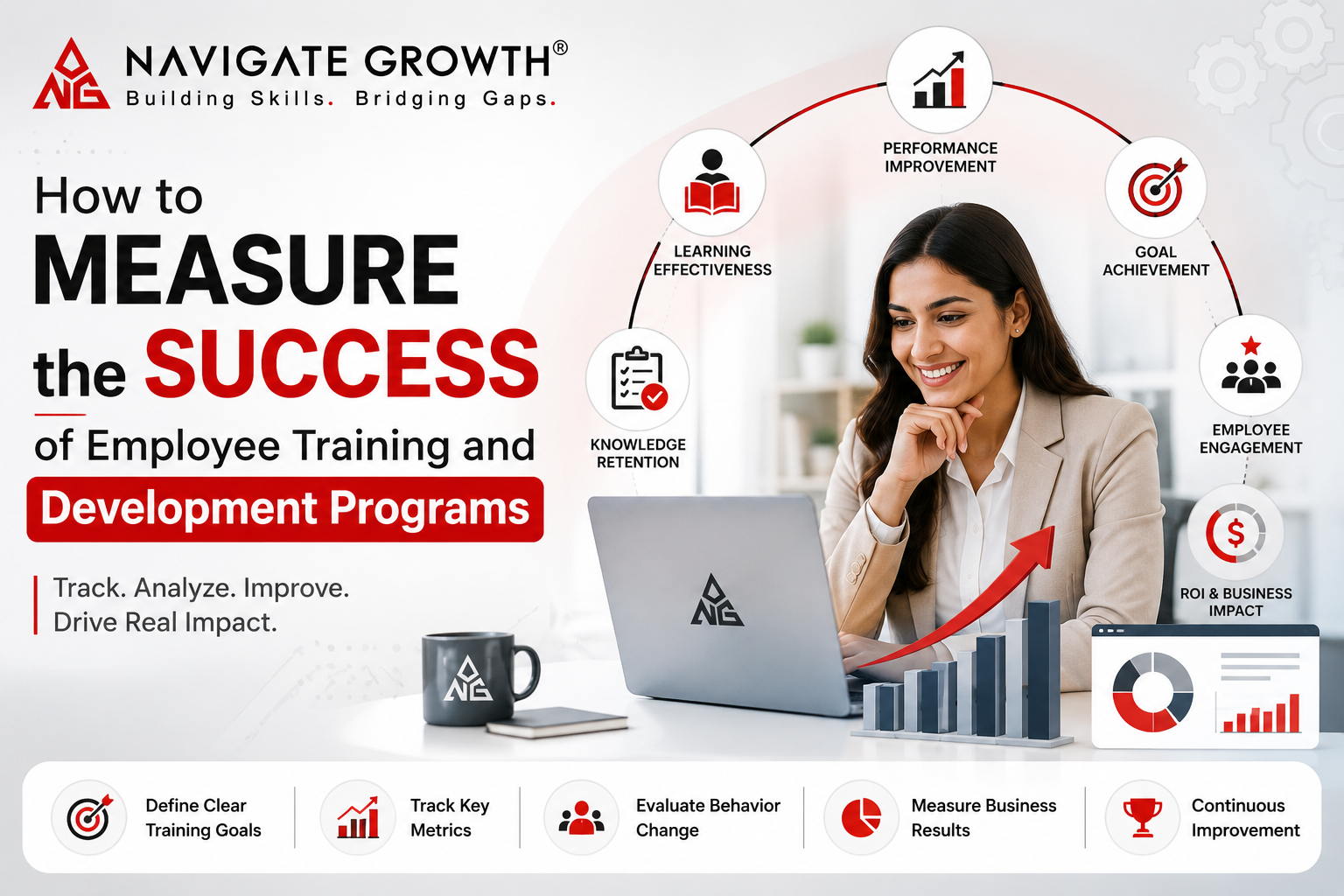
Measuring training success ensures that learning initiatives contribute to organizational growth.
Organizations can evaluate success through different methods:
1 Employee Performance Improvement
Compare employee performance before and after training.
Indicators include:
- Increased productivity
- Better quality output
- Improved decision-making
- Reduced errors
2 Employee Feedback
Employee surveys help understand whether training content, delivery methods, and learning experiences were effective.
Feedback helps organizations improve future programs.
3 Return on Investment (ROI)
Training ROI evaluates whether the benefits generated from training justify the investment.
Companies can measure:
- Reduced operational costs
- Increased revenue
- Improved efficiency
- Lower employee turnover
4 Business Growth Metrics
The ultimate goal of training is business improvement.
Organizations should evaluate:
- Customer satisfaction
- Team performance
- Innovation levels
- Employee retention
- Revenue growth
9. Why Choose Navigate Growth for Employee Training and Development Programs
Organizations need training solutions that are practical, customized, and aligned with business goals. Navigate Growth helps companies develop skilled employees through structured learning strategies designed for modern workplaces.
Navigate Growth focuses on creating impactful employee training and development programs that improve employee capabilities, strengthen leadership skills, and enhance workplace performance.
The training solutions include:
- Leadership development programs
- Manager training
- Employee skill enhancement
- Communication development
- Workplace learning solutions
With customized strategies and practical learning methods, Navigate Growth supports businesses in building confident employees and future-ready teams.
Conclusion
In a rapidly changing business environment, organizations cannot rely only on existing employee skills. Continuous learning and development have become essential for maintaining productivity, innovation, and competitiveness.
Advanced employee training and development programs help businesses improve workforce capabilities, strengthen leadership, increase employee engagement, and achieve long-term growth.
From leadership development and digital skills training to communication improvement and mentorship programs, organizations can choose different learning strategies based on their goals and workforce requirements.
Companies that prioritize employee development create a culture of continuous improvement where employees feel valued and motivated to perform better.
Investing in employee learning is not just about improving individual performance; it is about building a stronger organization prepared for future challenges.
Frequently Asked Questions (FAQs)
1. What are employee training and development programs?
Employee training and development programs are structured learning initiatives designed to improve employees’ skills, knowledge, performance, and career growth. These programs help employees perform better in their current roles while preparing them for future responsibilities.
2. Why are employee training and development programs important?
These programs improve employee productivity, engagement, retention, leadership capabilities, and overall business performance. They help organizations adapt to technological changes and evolving market requirements.
3. What are the different types of employee training programs?
Common types include leadership training, technical skill development, communication training, sales training, compliance training, digital skills training, and mentorship programs.
4. How often should companies conduct employee training?
Companies should provide continuous learning opportunities instead of limiting training to yearly sessions. Regular training helps employees stay updated with industry trends and improve their skills.
5. How do organizations measure training effectiveness?
Organizations can measure effectiveness through employee performance, feedback surveys, productivity improvements, skill assessments, retention rates, and business outcomes.
6. What is the difference between employee training and employee development?
Training focuses on improving specific job-related skills, while development focuses on long-term career growth, leadership abilities, and future responsibilities.
7. How do employee training programs improve business growth?
Effective training improves workforce efficiency, reduces mistakes, enhances customer satisfaction, increases innovation, and helps organizations achieve better business results.
Contact Navigate Growth
Navigate Growth
Address: Vivek Khand, Gomti Nagar, Lucknow, India
Phone:
📞 +91 99569 98880
📞 +91 94100 66699
Email:
✉️ contact@navigategrowth.in
✉️ niharikagangwar@navigategrowth.in
Website:
🌐 https://navigategrowth.in/
Instagram:
📷 https://www.instagram.com/thegrowthmindset.official/
Connect with Navigate Growth for professional employee training and development programs, leadership development programs, and corporate training solutions designed to improve workforce skills and business performance.