
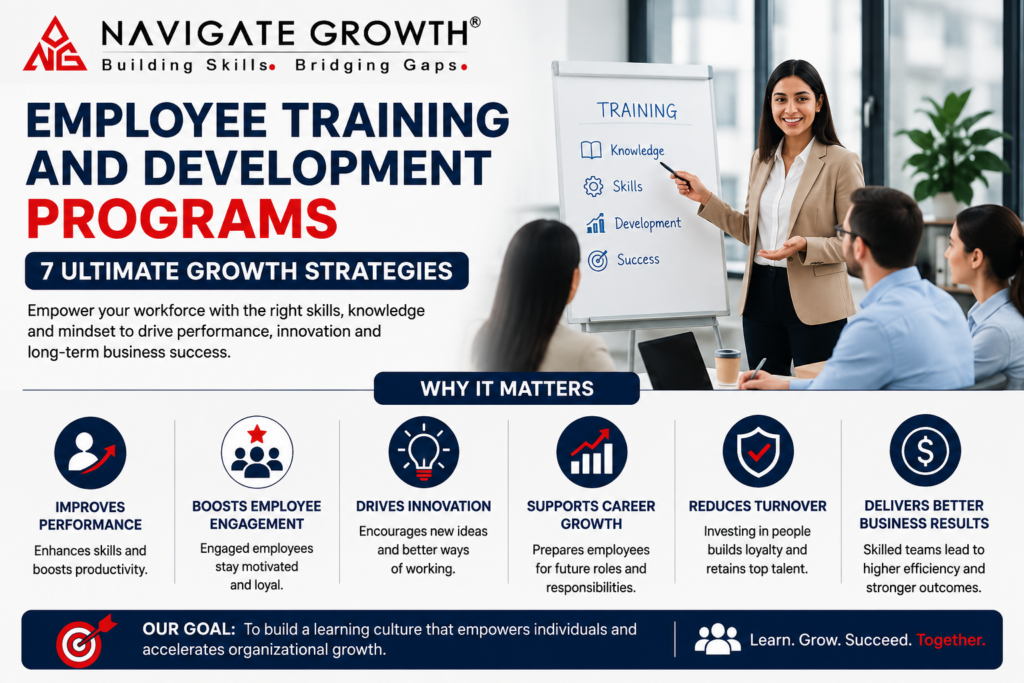
Employee Training and development programs 7 Ultimate Growth
Discover 7 employee training and development programs to improve skills, boost growth, and build a strong, future-ready workforce.
Table of Contents
- Introduction to Employee Training and Development Programs
- Importance of Employee Training and Development Programs
- Objectives of Training and Development
- Types of Employee Training and Development Programs
- Core Elements of an Effective Training Strategy
- Common Challenges in Training Implementation
- 7 Ultimate Employee Training and Development Programs for Growth
- AI and Technology in Modern Training Systems
- Leadership Development for Managers
- Measuring Training Effectiveness (KPIs and ROI)
- Best Practices for Long-Term Success
- Future Trends in Employee Learning and Development
- Conclusion
1. Introduction to Employee Training and Development Programs
In today’s fast-changing business environment, organizations are operating in a world where technology evolves rapidly, customer expectations shift frequently, and competition grows stronger every year. In such a scenario, companies can no longer depend only on hiring skilled employees from the market. Instead, they must focus on continuously improving the skills of their existing workforce.
This is exactly where employee training and development programs play a critical role in organizational success.
These programs are structured and systematic learning initiatives designed to improve employee performance, enhance job-related skills, and prepare individuals for future responsibilities. The main goal is not just to improve what employees do today, but also to prepare them for tomorrow’s challenges.
Training typically focuses on immediate job requirements. For example, teaching an employee how to use a new software tool, operate machinery, or follow a new process. Development, on the other hand, focuses on long-term growth. It includes leadership skills, strategic thinking, decision-making ability, communication improvement, and overall career development.
For example, a sales executive may undergo training on CRM software usage, while development programs may prepare that same employee for a future sales manager role by improving negotiation skills and leadership capabilities.
In 2026, the concept of workplace learning has changed significantly. Traditional classroom-based training is now combined with digital learning platforms, AI-driven learning systems, virtual simulations, and micro-learning modules. This hybrid learning environment allows employees to learn anytime and anywhere.
Modern organizations are increasingly recognizing that employee training and development programs are not just HR activities but strategic business investments. Companies that actively invest in employee development are more adaptable, innovative, and resilient in times of change.
On the other hand, organizations that ignore structured learning systems often face skill gaps, reduced productivity, employee dissatisfaction, and high turnover rates. This directly impacts long-term business growth and competitiveness.
Therefore, continuous learning has become a core part of modern workplace culture.
2. Why Employee Training and Development Programs Matter
The importance of structured learning systems has increased significantly in recent years. Businesses across industries are realizing that employee skills must evolve continuously to match market demands.
1. Improves Overall Productivity
One of the most important benefits of employee training and development programs is improved productivity. When employees are properly trained, they understand their tasks more clearly and perform them more efficiently. This reduces errors, improves accuracy, and saves valuable time.
For instance, in customer service departments, trained employees handle customer queries faster and more effectively, leading to improved customer satisfaction.
2. Enhances Employee Engagement and Motivation
Employees feel more valued when companies invest in their growth. Training programs show that the organization cares about their future, not just their current output. This increases motivation, engagement, and loyalty.
Engaged employees are more likely to contribute innovative ideas, take ownership of their tasks, and collaborate effectively with their teams.
3. Reduces Employee Turnover
High employee turnover is expensive for any organization. Recruitment, onboarding, and training new employees require time and resources. When companies provide continuous learning opportunities, employees are more likely to stay longer.
People prefer working in organizations where they can grow their careers.
4. Builds a Strong Leadership Pipeline
Every organization needs future leaders. Through structured development programs, employees are prepared for leadership roles over time. This reduces dependency on external hiring for managerial positions.
Leadership training helps employees develop skills like decision-making, team management, conflict resolution, and strategic thinking.
5. Increases Organizational Efficiency
Well-trained employees make fewer mistakes and require less supervision. This improves operational efficiency and reduces management workload.
For example, in manufacturing companies, proper training reduces machine breakdowns and workplace accidents.
6. Strengthens Company Culture
Training also plays an important role in shaping workplace culture. It promotes values such as teamwork, accountability, innovation, and continuous improvement.
A strong learning culture helps organizations become more adaptive and future-ready.
3. Key Objectives of Training and Development
Every organization must define clear goals before implementing employee training and development programs. Without clear objectives, training becomes random and ineffective.
1. Skill Development and Enhancement
The primary objective is to improve employee skills related to their current job roles. This includes technical skills, software knowledge, and operational expertise.
2. Performance Improvement
Training programs are designed to improve employee performance by reducing errors and increasing efficiency.
3. Career Advancement Preparation
Development programs help employees prepare for future promotions and higher responsibilities within the organization.
4. Behavioral and Soft Skill Improvement
Soft skills like communication, teamwork, leadership, emotional intelligence, and problem-solving are essential for workplace success.
5. Innovation and Creativity Enhancement
Training encourages employees to think creatively and develop innovative solutions for business challenges.
6. Adaptation to Technological Changes
With constant technological advancement, employees must learn new tools and systems regularly to stay relevant.
7. Alignment with Business Goals
Effective training ensures that employee development aligns with the overall strategic goals of the organization.
4. Types of Employee Training and Development Programs
Organizations use different types of training programs depending on their needs and industry requirements.
1. Onboarding Training Programs
Onboarding is the first step in employee development. It introduces new employees to company culture, policies, workflows, and job responsibilities. A strong onboarding process improves retention and reduces confusion during the early stages of employment.
2. Technical Training Programs
Technical training focuses on job-specific skills. Examples include:
- Software training for IT professionals
- Machine operation training in manufacturing
- Digital marketing tools for marketers
- Financial tools for accountants
3. Soft Skills Training Programs
Soft skills are essential for workplace success. These programs focus on:
- Communication skills
- Leadership development
- Emotional intelligence
- Team collaboration
- Time management
4. Leadership Development Programs
These programs prepare employees for managerial and leadership roles. They focus on decision-making, strategic planning, and team management abilities.
5. Compliance and Safety Training
Compliance training ensures employees understand legal, ethical, and safety guidelines. This is crucial in industries like healthcare, construction, and finance.
6. Continuous Learning Programs
Continuous learning is an ongoing process where employees regularly update their skills through workshops, webinars, e-learning modules, and mentoring sessions.
Modern organizations are increasingly using AI-based learning platforms to personalize training content for employees based on their performance and skill gaps.
5. Core Elements of a Successful Training Strategy
A successful employee training and development programs framework requires careful planning and execution.
1. Skill Gap Identification
Before designing any training program, organizations must identify existing skill gaps within their workforce.
2. Clear Learning Outcomes
Each training program should have measurable outcomes that define what employees will learn.
3. Engaging Learning Methods
Modern training programs use interactive methods such as:
- Gamification
- Videos
- Real-life case studies
- Role-playing exercises
- Virtual simulations
These methods improve engagement and knowledge retention.
4. Experienced Trainers and Mentors
Trainers must have both theoretical knowledge and practical experience to deliver effective learning.
5. Practical Application of Knowledge
Employees should be able to apply what they learn directly in their job roles. This ensures better retention and real-world impact.
6. Continuous Feedback System
Feedback from employees helps improve training quality and effectiveness.
7. Performance Measurement
Organizations use KPIs such as productivity improvement, error reduction, employee retention, and job satisfaction to measure success.
6. Common Challenges Organizations Face
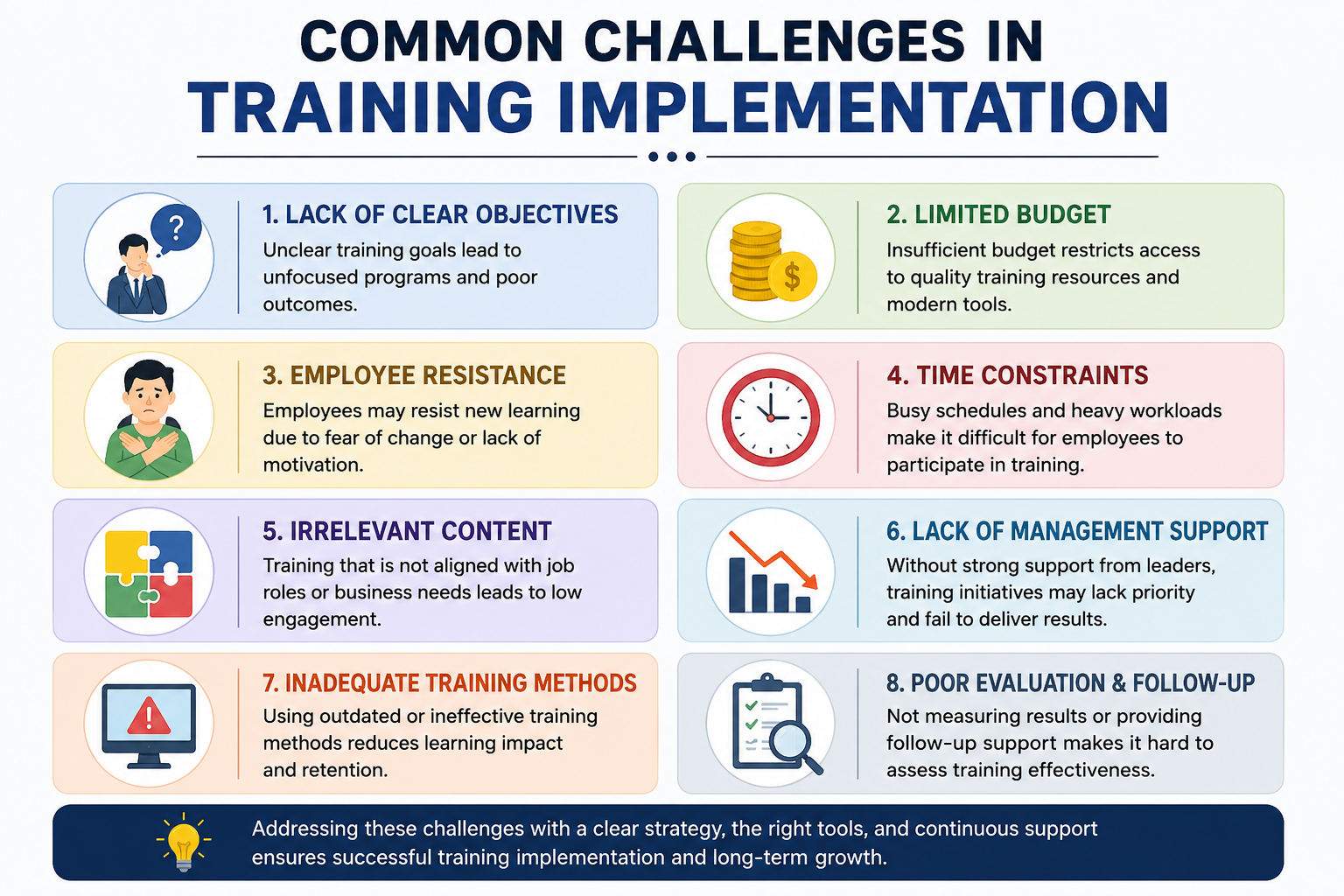
Even though employee training and development programs are essential, many organizations struggle with their implementation.
1. Lack of Employee Engagement
Employees may lose interest if training is not interactive or relevant to their job roles.
2. Budget Limitations
Small businesses often struggle to allocate sufficient budgets for structured training programs.
3. Time Constraints
Employees may find it difficult to attend training sessions due to heavy workloads.
4. Resistance to Change
Some employees resist learning new technologies or methods due to comfort with existing systems.
5. Lack of Measurement Tools
Without proper tracking systems, organizations cannot evaluate the effectiveness of training programs.
6. Outdated Content
If training materials are not updated regularly, employees may learn outdated or irrelevant skills.
To overcome these challenges, organizations are adopting flexible learning models, micro-learning techniques, and AI-powered platforms that personalize learning experiences based on employee needs.
7 Powerful Employee Training and Development Programs for Growth
Modern organizations rely on structured employee training and development programs to build skilled, adaptable, and future-ready teams. Below are 7 powerful programs that directly improve performance and long-term growth.
1. On-the-Job Training (OJT)
On-the-job training is one of the most practical methods where employees learn by doing real tasks in the workplace. Instead of theoretical learning, employees gain hands-on experience under supervision.
This method is highly effective because employees immediately apply what they learn. For example, a new sales executive learns how to handle clients by shadowing an experienced team member.
OJT improves confidence, reduces mistakes, and speeds up learning.
2. Leadership Development Programs
Leadership training is essential for preparing future managers. These programs focus on decision-making, team management, conflict resolution, and strategic thinking.
Strong leadership development ensures that companies always have capable leaders ready for higher roles. This reduces dependency on external hiring and improves internal growth.
Employees trained under leadership programs often show higher accountability and better problem-solving abilities.
3. Technical Skill Enhancement Programs
These programs focus on improving job-specific technical skills such as software usage, machinery handling, coding, data analysis, or digital tools.
For example, IT employees may receive training on cloud computing or cybersecurity tools.
These programs ensure employees remain updated with evolving technologies and industry standards.
4. Soft Skills Development Programs
Soft skills are equally important as technical skills. These programs focus on communication, teamwork, emotional intelligence, and time management.
Employees with strong soft skills perform better in collaborative environments and handle workplace challenges more effectively.
This type of training improves workplace relationships and overall productivity.
5. Compliance Training Programs
Compliance training ensures employees follow legal, ethical, and safety standards. It is especially important in industries like healthcare, finance, manufacturing, and construction.
Topics include workplace safety, data protection laws, anti-harassment policies, and industry regulations.
These programs reduce legal risks and create a safer workplace environment.
6. Continuous Learning Programs
Continuous learning is an ongoing development process where employees regularly update their knowledge through online courses, webinars, and workshops.
These programs are flexible and allow employees to learn at their own pace.
Organizations that promote continuous learning build a culture of innovation and adaptability.
7. Cross-Functional Training Programs
Cross-functional training allows employees to learn skills outside their primary job roles. For example, a marketing employee may learn basic sales or analytics skills.
This improves workforce flexibility and helps employees understand how different departments work together.
It also prepares employees for multi-role responsibilities in future.
8. AI and Technology in Modern Training Systems
Technology has completely transformed employee training and development programs. Artificial Intelligence (AI), machine learning, and automation tools now make learning more personalized and efficient.
AI-based learning platforms analyze employee performance and recommend customized training modules. This ensures that employees learn exactly what they need to improve.
For example, if an employee struggles with communication skills, the system automatically suggests relevant soft skills courses.
Virtual Reality (VR) and Augmented Reality (AR) are also being used for immersive training experiences. In industries like healthcare and aviation, VR simulations allow employees to practice real-life scenarios safely.
Technology makes training more engaging, measurable, and scalable across large organizations.
9. Leadership Development Programs for Managers
Leadership development is a core part of advanced employee training and development programs. Managers are responsible for guiding teams, making decisions, and driving performance.
These programs focus on:
- Strategic thinking and planning
- Team leadership and motivation
- Conflict resolution techniques
- Decision-making under pressure
- Communication and negotiation skills
Leadership programs often include mentorship, coaching sessions, and real-world case studies.
Strong leadership ensures better team coordination and improved organizational performance.
Measuring Training Effectiveness (KPIs & ROI)
To ensure training success, organizations must measure performance using KPIs (Key Performance Indicators) and ROI (Return on Investment).
Important KPIs include:
- Employee productivity improvement
- Reduction in errors
- Training completion rate
- Employee satisfaction score
- Retention rate improvement
ROI measurement includes:
ROI evaluates whether the benefits of training outweigh the costs. For example, if training improves productivity and reduces operational costs, it is considered successful.
Tracking ROI helps organizations improve future training strategies and optimize budgets.
10. Best Practices for Long-Term Success
To build effective employee training and development programs, organizations must follow best practices:
1. Align Training with Business Goals
Training should support organizational objectives such as growth, innovation, and efficiency.
2. Keep Learning Interactive
Use videos, quizzes, simulations, and group activities to increase engagement.
3. Personalize Learning Paths
Different employees have different learning needs. Personalized training improves results.
4. Encourage Continuous Feedback
Regular feedback helps improve both employee performance and training quality.
5. Promote a Learning Culture
Organizations should encourage employees to continuously upgrade their skills.
11. Future Trends in Employee Learning and Development
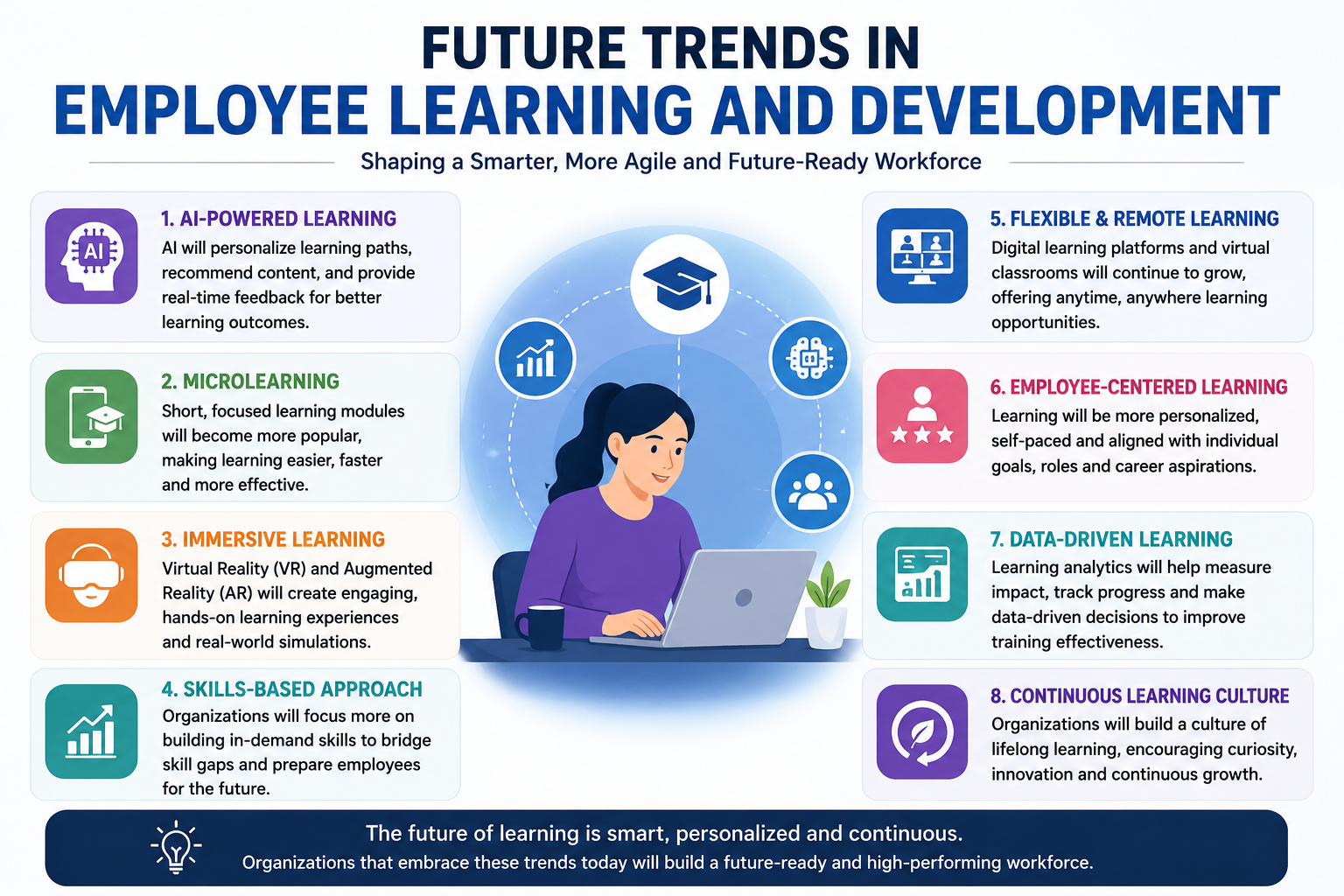
The future of employee training and development programs is driven by innovation and technology.
1. AI-Powered Learning Systems
AI will continue to personalize training experiences for employees.
2. Microlearning Modules
Short, focused learning sessions will replace long training programs.
3. Gamification
Training will become more interactive using game-based learning techniques.
4. Remote Learning Expansion
With hybrid work models, remote training will become standard.
5. Data-Driven Training Decisions
Companies will rely on analytics to improve training effectiveness.
12. Conclusion
Employee training and development programs are a vital part of building a strong, skilled, and future-ready workforce. These programs help employees improve their current job performance while also preparing them for future responsibilities and leadership roles. By investing in continuous learning, organizations can increase productivity, reduce skill gaps, and improve employee satisfaction and retention.
Modern businesses are also using advanced tools like AI-based learning systems, microlearning, and virtual training methods to make learning more effective and personalized. A well-structured training system not only supports individual employee growth but also strengthens overall organizational performance and competitiveness. In today’s fast-changing business world, continuous learning is no longer optional—it is essential for long-term success.
13. FAQs
1. What are employee training and development programs?
Employee training and development programs are structured learning activities designed to improve employee skills, knowledge, and performance. Training focuses on current job skills, while development prepares employees for future roles and responsibilities within the organization.
2. Why are employee training and development programs important?
These programs improve productivity, reduce errors, and increase employee satisfaction. They also help organizations build skilled teams, reduce employee turnover, and develop future leaders from within the company.
3. What types of employee training programs are commonly used?
Common types include onboarding training, technical skill training, soft skills development, leadership training, compliance training, and continuous learning programs. Each type helps employees grow in different areas.
4. How do employee training and development programs benefit businesses?
They help businesses improve efficiency, increase employee performance, and support innovation. Well-trained employees work more confidently, adapt to changes faster, and contribute to long-term organizational growth.
 Contact Us
Looking to implement effective employee training and development programs ? Reach out to our team for customized solutions.
 Address:
Vivek Khand, Gomti Nagar, Lucknow, India
 Email:
 Phone:
- +91 99569 98880
- +91 94100 66699
 Website:
https://navigategrowth.in/
Instagram: https://www.instagram.com/thegrowthmindset.official/