Introduction Employment Training and Development Programs
In today’s fast-changing business environment, organizations can no longer rely only on hiring talented employees. They must continuously develop their workforce to remain competitive. This is where employment training and development programs play a vital role. These programs help employees gain new knowledge, improve technical and soft skills, and prepare for future responsibilities. Whether a company is a startup, a small business, or a multinational organization, investing in employee learning creates a more productive, engaged, and future-ready workforce.
Technology, automation, artificial intelligence, and changing customer expectations are transforming workplaces across industries. Employees must constantly update their skills to keep pace with these changes. Businesses that fail to provide learning opportunities often experience lower productivity, reduced employee engagement, higher turnover, and difficulty adapting to market demands. On the other hand, organizations that invest in employment training and development programs build stronger teams, improve employee retention, and achieve sustainable business growth.
Modern businesses no longer view training as a one-time activity. Instead, they treat learning as an ongoing process that supports career growth, leadership development, innovation, and organizational success. From onboarding new employees to preparing future managers, every stage of the employee journey benefits from structured learning programs.
Companies such as Navigate Growth understand that every organization has unique training needs. Customized corporate learning solutions help businesses bridge skill gaps, improve workplace performance, and develop leaders who can drive long-term success.
Some of the most common goals of employment training and development programs include:
- Improving employee performance
- Building leadership capabilities
- Enhancing communication and teamwork
- Increasing productivity
- Developing technical expertise
- Strengthening customer service skills
- Preparing employees for future roles
- Supporting digital transformation
- Creating a culture of continuous learning
Today, organizations are increasingly investing in workforce training solutions because skilled employees contribute directly to better customer satisfaction, improved innovation, and stronger financial performance. As industries continue evolving, continuous employee development has become a business necessity rather than an optional benefit.
What Are Employment Training and Development Programs?
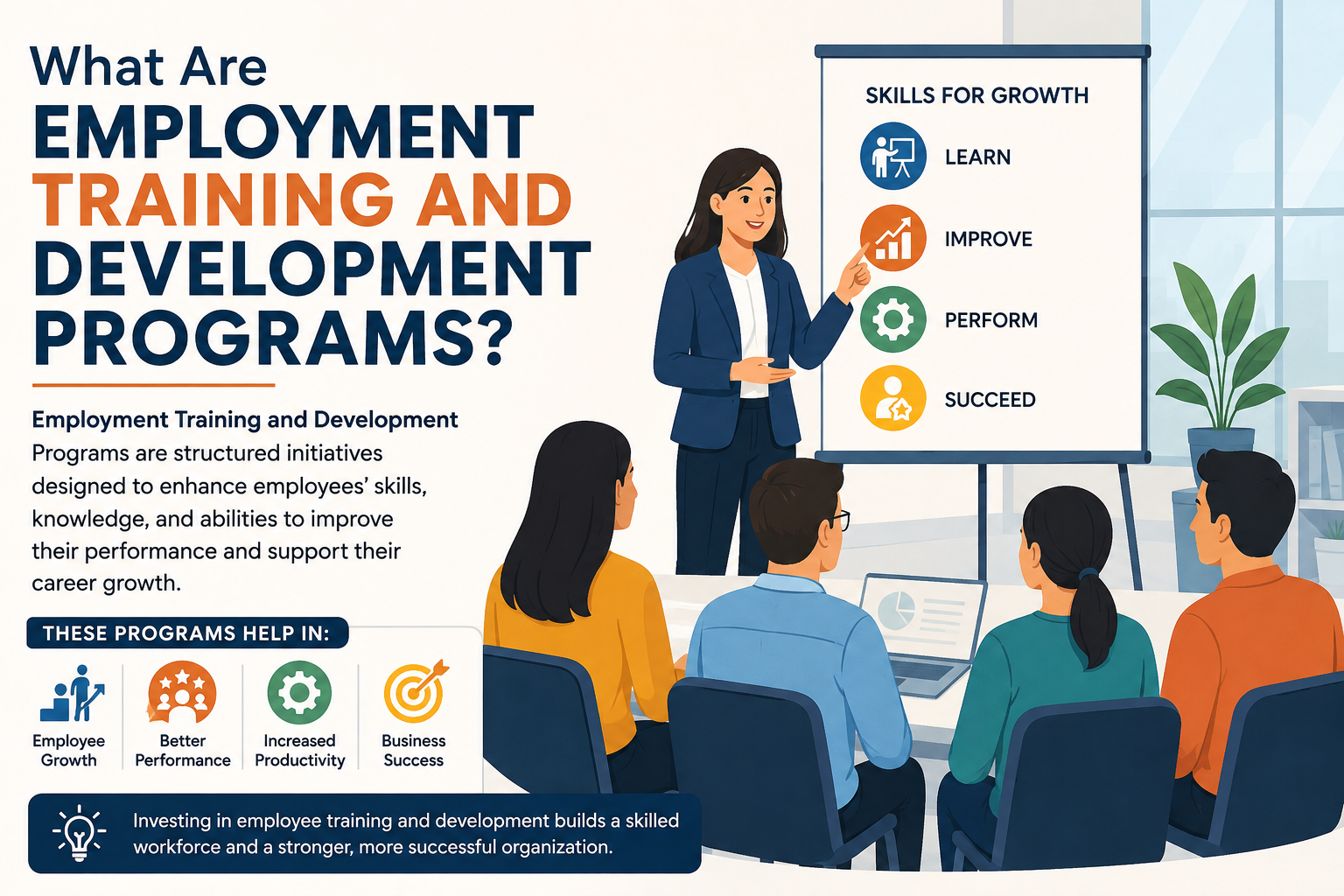
Employment training and development programs are structured learning initiatives designed to improve employees’ knowledge, skills, abilities, and professional competencies. These programs help individuals perform their current roles more effectively while preparing them for future responsibilities within the organization.
Although the terms “training” and “development” are often used together, they have different purposes.
| Training | Development |
|---|---|
| Focuses on current job performance | Focuses on long-term career growth |
| Improves specific skills | Builds leadership and strategic capabilities |
| Usually short-term | Usually continuous |
| Addresses immediate skill gaps | Prepares employees for future opportunities |
| Task-oriented | Career-oriented |
Training teaches employees how to perform specific tasks efficiently, while development prepares them for higher responsibilities, leadership positions, and changing business environments.
Most organizations combine both approaches to create comprehensive employment training and development programs that support employees throughout their careers.
These programs may include:
| Program Type | Purpose |
|---|---|
| Onboarding Training | Introduce new employees to company culture and policies |
| Technical Skills Training | Improve job-specific knowledge |
| Leadership Development | Prepare future managers |
| Communication Skills Training | Improve collaboration |
| Compliance Training | Meet legal and industry requirements |
| Digital Skills Training | Adapt to modern technologies |
| Customer Service Training | Enhance customer experience |
| Diversity and Inclusion Training | Promote an inclusive workplace |
Modern organizations increasingly use blended learning methods, including classroom sessions, online learning, virtual workshops, coaching, mentoring, simulations, and interactive learning platforms. These approaches allow employees to learn at their own pace while gaining practical experience.
High-performing companies regularly evaluate employee skills, identify knowledge gaps, and create personalized learning paths. This ensures every employee receives relevant training that aligns with business goals.
Some important secondary concepts closely associated with employment training and development programs include:
- Employee training and development
- Corporate training programs
- Workforce training solutions
- Employee skill development
- Professional development
- Workplace learning programs
- Leadership development programs
- Learning and development (L&D)
- Upskilling employees
- Reskilling workforce
- Performance improvement training
- Organizational development
- Employee engagement strategies
- Career development programs
- Management training
Together, these initiatives help organizations build stronger teams, improve business performance, and stay competitive in today’s rapidly changing economy.
Why Employment Training and Development Programs Matter
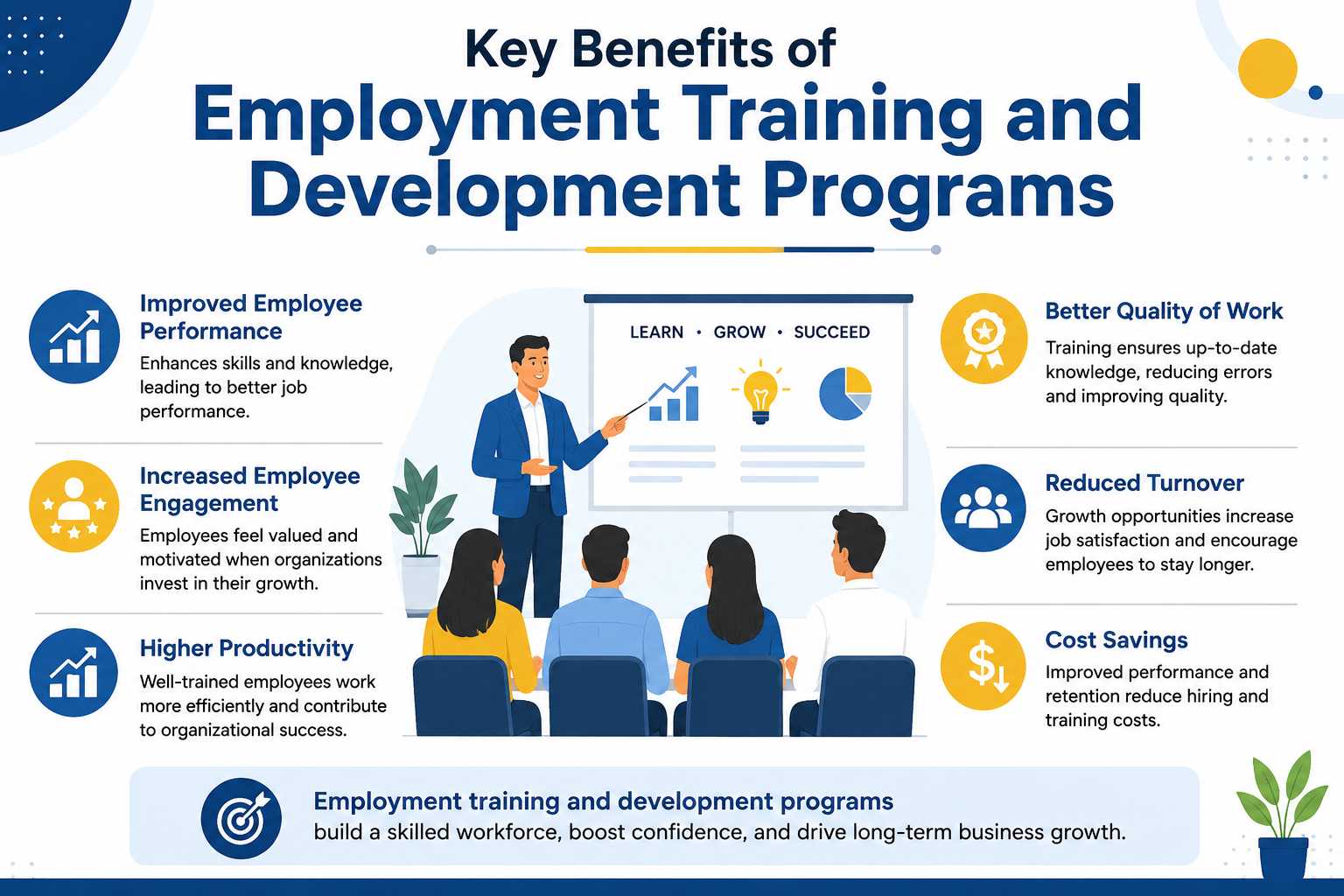
Organizations that prioritize employment training and development programs gain a significant competitive advantage. Skilled employees perform better, adapt faster to change, and contribute more effectively toward organizational objectives.
Training is no longer simply about teaching new employees. It has become an essential strategy for improving productivity, innovation, employee satisfaction, and long-term business growth.
Employment training and development programs help organizations create a workplace where employees are motivated to grow, solve problems, and contribute new ideas. Regular skill development improves efficiency, boosts job satisfaction, enhances teamwork, and prepares employees to take on greater responsibilities as business needs evolve.
1 Improve Employee Performance
Well-trained employees understand their responsibilities more clearly and complete tasks more efficiently. They make fewer mistakes, require less supervision, and consistently deliver higher-quality work.
Continuous learning enables employees to improve both technical expertise and workplace skills, resulting in stronger individual and team performance.
2 Increase Productivity
Employees equipped with updated knowledge complete tasks faster and use organizational resources more effectively. As productivity increases, businesses reduce operational costs while improving overall efficiency.
Regular employment training and development programs also help streamline workflows and improve collaboration across departments.
3 Reduce Employee Turnover
Employees are more likely to remain with organizations that invest in their professional growth. Career development opportunities increase job satisfaction and strengthen employee loyalty.
Providing continuous learning demonstrates that the organization values its workforce, leading to improved retention and reduced recruitment costs.
4 Build Future Leaders
Leadership development is one of the most valuable outcomes of effective training programs. Organizations need capable managers who can guide teams, solve problems, and make strategic decisions.
Leadership development programs help employees strengthen communication, decision-making, conflict resolution, emotional intelligence, and people management skills.
5 Support Digital Transformation
Rapid technological advancement requires employees to continually update their knowledge. Digital skills training helps organizations successfully adopt automation, artificial intelligence, cloud technologies, and modern workplace tools.
Upskilling employees reduces resistance to change and improves technology adoption across the organization.
6 Improve Employee Engagement
Employees who receive continuous learning opportunities feel more motivated and confident in their roles. Learning keeps work interesting and encourages individuals to contribute innovative ideas.
Engaged employees typically demonstrate:
- Higher motivation
- Better teamwork
- Stronger commitment
- Increased creativity
- Improved customer service
7 Enhance Customer Satisfaction
Employees with better communication, product knowledge, and problem-solving abilities deliver superior customer experiences.
Customer-facing teams trained through employment training and development programs respond more effectively to customer needs, resulting in stronger relationships and increased customer loyalty.
8 Encourage Innovation
Continuous learning exposes employees to new ideas, technologies, and industry best practices. This encourages creative thinking and helps organizations remain competitive in evolving markets.
Innovative employees identify better ways to solve problems, improve processes, and create greater value for customers.
Business Benefits at a Glance
| Business Objective | How Employment Training and Development Programs Help |
|---|---|
| Higher Productivity | Employees work faster and more accurately |
| Better Employee Retention | Learning opportunities increase loyalty |
| Improved Leadership | Develop future managers and team leaders |
| Increased Employee Engagement | Higher motivation and workplace satisfaction |
| Stronger Customer Experience | Better service and communication |
| Digital Readiness | Employees adapt to new technologies |
| Improved Collaboration | Better teamwork across departments |
| Competitive Advantage | Skilled workforce drives business growth |
Ultimately, employment training and development programs are not just an HR initiative—they are a strategic investment in organizational success. Businesses that prioritize employee skill development, workforce training solutions, leadership development programs, workplace learning programs, and continuous professional development are better equipped to meet changing market demands, retain top talent, and achieve sustainable long-term growth.
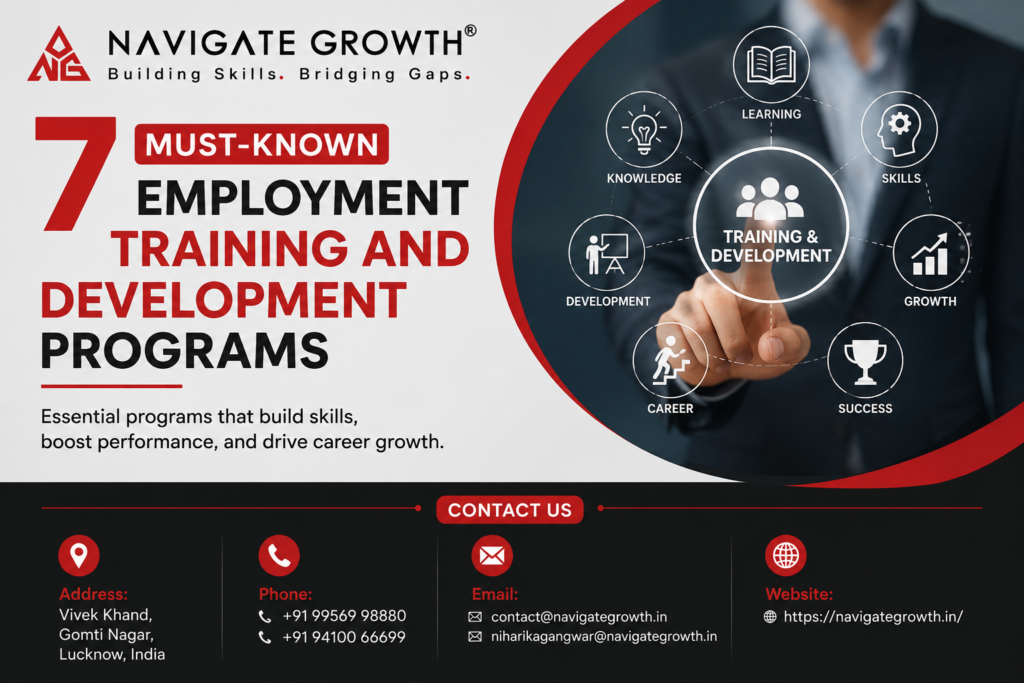
7 Must-Known Employment Training and Development Programs
Organizations invest in employment training and development programs to improve employee performance, close skill gaps, and prepare their workforce for future challenges. A well-designed training strategy helps employees gain confidence, increase productivity, and contribute more effectively to business goals. Below are seven essential programs that every organization should consider as part of its learning and development (L&D) strategy.
1 Onboarding Training Program
An onboarding training program is the first step in helping new employees become productive members of an organization. It introduces them to the company’s mission, values, culture, policies, job responsibilities, and workplace expectations. Effective onboarding reduces confusion, improves employee engagement, and shortens the time it takes for new hires to perform independently.
A strong onboarding program typically includes company orientation, role-specific training, introductions to team members, compliance guidelines, and access to learning resources. Businesses that invest in structured onboarding often experience higher employee retention and faster productivity.
Key Benefits:
- Faster adaptation to the workplace
- Better employee confidence
- Higher job satisfaction
- Improved retention rates
2 Technical Skills Training Program
Technical skills training focuses on improving the job-specific knowledge employees need to perform their roles efficiently. As industries continue to evolve with new technologies and tools, organizations must regularly update employees’ technical capabilities.
Examples include software training, machine operation, data analysis, coding, cybersecurity awareness, project management tools, and industry-specific certifications. Regular technical training ensures employees stay competitive while helping businesses maintain high-quality standards.
| Focus Area | Examples |
|---|---|
| Software Skills | Microsoft Office, ERP, CRM, AI tools |
| IT & Technology | Programming, Cloud Computing, Cybersecurity |
| Industry Skills | Manufacturing, Healthcare, Finance |
| Professional Certifications | Technical and industry-recognized courses |
Technical training strengthens workforce training solutions and supports continuous employee skill development across the organization.
3 Soft Skills Development Program
While technical knowledge is important, soft skills determine how employees communicate, collaborate, and solve workplace challenges. Soft skills development programs help employees build interpersonal abilities that improve teamwork and workplace relationships.
Common training topics include communication, emotional intelligence, critical thinking, time management, problem-solving, adaptability, conflict resolution, teamwork, and presentation skills.
Organizations with employees who possess strong soft skills often experience better collaboration, improved customer interactions, and higher employee engagement.
Popular Soft Skills Covered
- Communication
- Teamwork
- Leadership
- Emotional intelligence
- Decision-making
- Time management
- Conflict resolution
- Adaptability
Soft skills training is a key component of modern employment training and development programs because it enhances both individual and organizational performance.
4 Leadership Development Program
Leadership development programs prepare employees to take on managerial and leadership responsibilities. Rather than waiting until someone is promoted, organizations proactively develop leadership competencies throughout an employee’s career.
Training usually focuses on strategic thinking, coaching, delegation, motivation, decision-making, performance management, and change management. Future leaders also learn how to inspire teams, manage conflicts, and achieve organizational objectives.
Leadership development helps businesses build a strong succession pipeline while reducing the risks associated with leadership transitions.
Benefits of Leadership Development
- Develops future managers
- Improves employee motivation
- Strengthens decision-making
- Encourages innovation
- Supports business growth
Leadership training is one of the most valuable corporate training programs because effective leaders directly influence employee performance and organizational success.
5 Compliance and Workplace Safety Training
Compliance and workplace safety training ensures employees understand legal regulations, organizational policies, and workplace safety procedures. Every organization has a responsibility to provide a safe and legally compliant working environment.
Training topics may include workplace ethics, data privacy, anti-harassment policies, occupational health and safety, fire safety, emergency response, cybersecurity awareness, and industry regulations.
Regular compliance training minimizes legal risks while creating a culture of responsibility and accountability.
| Training Area | Purpose |
|---|---|
| Workplace Safety | Reduce accidents and injuries |
| Compliance Policies | Meet legal requirements |
| Cybersecurity | Protect company information |
| Ethics Training | Promote professional conduct |
| Emergency Procedures | Improve workplace preparedness |
This type of training protects both employees and the organization while supporting long-term operational success.
6 Customer Service Training Program
Customer service training equips employees with the skills needed to deliver exceptional customer experiences. Since customer satisfaction directly affects business growth, organizations invest in training that improves communication, problem-solving, and relationship-building abilities.
Employees learn how to understand customer needs, manage complaints professionally, resolve conflicts, communicate effectively, and build lasting customer relationships.
A successful customer service training program often includes role-playing exercises, real-life case studies, product knowledge sessions, and communication workshops.
Key Outcomes
- Improved customer satisfaction
- Better communication skills
- Faster issue resolution
- Increased customer loyalty
- Stronger company reputation
Organizations that prioritize customer service training often gain a competitive advantage through higher customer retention and positive brand perception.
7 Digital Skills and Technology Training
Digital transformation has made technology training essential for organizations across every industry. Digital skills and technology training help employees confidently use modern workplace tools and adapt to emerging technologies.
Training may include artificial intelligence (AI), cloud computing, digital collaboration platforms, automation software, cybersecurity practices, data analytics, digital marketing, and remote work technologies.
As businesses continue embracing digital transformation, employees with strong digital capabilities become more productive, innovative, and adaptable.
Common Digital Skills
- Artificial Intelligence (AI)
- Cloud Computing
- Data Analytics
- Microsoft 365 and Google Workspace
- Digital Collaboration Tools
- Cybersecurity Awareness
- Automation Software
- Digital Marketing Platforms
Digital learning has become one of the fastest-growing areas within employment training and development programs. It helps organizations future-proof their workforce, improve operational efficiency, and stay competitive in an increasingly technology-driven business environment.
Employment training and development programs are essential for organizations that want to build a skilled, productive, and future-ready workforce. By implementing businesses can improve employee performance, increase engagement, and prepare teams for changing industry demands. Effective employment training and development programs also help develop leadership skills, strengthen technical expertise, and improve customer service, leading to long-term business growth. Organizations that continuously invest in employment training and development programs gain a competitive advantage through higher productivity, better employee retention, and a strong culture of continuous learning.
Frequently Asked Questions (FAQs)
Q1. What are employment training and development programs?
Employment training and development programs are structured learning initiatives designed to improve employees’ knowledge, technical skills, soft skills, and professional growth while supporting organizational objectives.
Q2. Why are employment training and development programs important?
They improve employee performance, increase productivity, strengthen leadership, reduce turnover, and help organizations stay competitive.
Q3. What is the difference between training and development?
Training focuses on improving skills for current job responsibilities, while development prepares employees for future leadership and career growth.
Q4. Which employment training program is most important?
The best program depends on organizational needs. Common options include onboarding, leadership development, technical skills training, soft skills training, compliance training, customer service training, and digital skills training.
Q5. How often should employees receive training?
Organizations should provide continuous learning throughout the year, including onboarding, refresher sessions, workshops, and advanced development programs.
Conclusion
Employment training and development programs are essential for organizations that want to build skilled, engaged, and future-ready teams. From onboarding new employees to developing leaders and strengthening digital capabilities, effective training improves productivity, employee satisfaction, and overall business performance. By identifying skill gaps, choosing the right learning methods, measuring results, and embracing modern workplace learning trends, organizations can create a culture of continuous improvement. Investing in employee training and development, leadership development programs, corporate training programs, workplace learning programs, and workforce training solutions is not just an investment in employees—it is a strategic investment in long-term business success. Continuous learning helps employees stay confident, adapt to changing workplace demands, and perform their roles more effectively. It strengthens both technical and interpersonal skills, encourages innovation, improves collaboration, and supports long-term career growth while helping organizations achieve higher productivity and sustainable success.
Contact Navigate Growth
Navigate Growth
Address: Vivek Khand, Gomti Nagar, Lucknow, India
Phone:
📞 +91 99569 98880
📞 +91 94100 66699
Email:
✉️ contact@navigategrowth.in
✉️ niharikagangwar@navigategrowth.in
Website:
🌐 https://navigategrowth.in/
Instagram:
📷 https://www.instagram.com/thegrowthmindset.official/
Connect with Navigate Growth for professional employee training and development programs, leadership development programs, and corporate training solutions designed to improve workforce skills and business performance.