
Introduction
In today’s fast-changing business environment, organizations can no longer rely only on hiring skilled professionals. Technology, customer expectations, and industry standards continue to evolve, making continuous learning essential for every workforce. This is why Employee Training and Development Programs have become a strategic investment rather than just an HR initiative. Companies that prioritize employee learning create stronger teams, improve productivity, and build a competitive advantage in the marketplace.
Whether an organization is a startup, a growing business, or a large enterprise, investing in employees helps improve performance, increase job satisfaction, and prepare future leaders. Well-designed Employee Training and Development Programs equip employees with the technical knowledge, soft skills, and leadership abilities needed to perform their roles effectively. At the same time, they help organizations adapt quickly to industry changes and business challenges.
Modern businesses are also facing skill gaps due to rapid digital transformation. New technologies such as artificial intelligence, automation, cloud computing, and data analytics require employees to continuously upgrade their knowledge. Organizations that ignore learning opportunities often struggle with reduced productivity, lower employee engagement, and higher turnover rates.
Companies like Navigate Growth understand that learning should not be a one-time event. Instead, it should be a continuous process supported by structured training, practical workshops, mentoring, coaching, and performance evaluations. By implementing effective Employee Training and Development Programs, businesses can develop confident employees who contribute to innovation, customer satisfaction, and long-term organizational success.
What Are Employee Training and Development Programs?
Employee Training and Development Programs are structured learning initiatives designed to improve employees’ knowledge, skills, competencies, and overall workplace performance. While training focuses on enhancing the skills required for current job responsibilities, development prepares employees for future roles, leadership opportunities, and career advancement.
These programs may be delivered through classroom sessions, instructor-led workshops, online learning platforms, webinars, coaching, mentoring, simulations, role-playing exercises, or hands-on practical training. Organizations often combine multiple learning methods to maximize employee engagement and knowledge retention.
The primary objective of Employee Training and Development Programs is to ensure employees remain competent, confident, and capable of meeting changing business requirements. They also help organizations create a culture of continuous improvement where learning becomes part of everyday work.
Training vs. Development
| Aspect | Training | Development |
|---|---|---|
| Primary Focus | Current job skills | Future career growth |
| Duration | Short-term | Long-term |
| Goal | Improve immediate performance | Build leadership and future capabilities |
| Audience | New and existing employees | High-potential employees and future leaders |
| Examples | Software training, compliance training | Leadership coaching, succession planning |
Although these terms are often used together, organizations achieve the best results when training and development work hand in hand. Effective Employee Training and Development Programs combine both approaches to create a skilled, adaptable, and future-ready workforce.
Why Employee Training and Development Programs Matter
Organizations that invest in Employee Training and Development Programs consistently outperform those that neglect employee learning. A knowledgeable workforce works more efficiently, adapts faster to change, and contributes more effectively toward achieving business goals.
As industries become increasingly competitive, companies must ensure their employees stay updated with the latest technologies, regulations, and best practices. Continuous learning reduces skill gaps while encouraging innovation and problem-solving across teams.
Another important reason these programs matter is employee engagement. Professionals are more likely to remain loyal to organizations that invest in their career growth. Learning opportunities increase motivation because employees feel valued and see a clear path for professional advancement.
Strong Employee Training and Development Programs also reduce costly workplace errors. Employees who understand company processes, safety requirements, customer service standards, and compliance regulations make fewer mistakes and deliver higher-quality work.
Furthermore, training prepares businesses for leadership succession. Organizations cannot depend solely on external hiring for management positions. Developing internal talent ensures business continuity and creates confident leaders who already understand the company’s culture and objectives.
Why Organizations Invest in Employee Training and Development Programs
| Business Need | How Training Helps |
|---|---|
| Higher productivity | Improves employee efficiency and work quality |
| Employee retention | Increases job satisfaction and career growth |
| Digital transformation | Builds new technology skills |
| Leadership pipeline | Develops future managers and team leaders |
| Better customer experience | Improves communication and service quality |
| Compliance | Reduces legal and operational risks |
When businesses treat learning as an ongoing investment rather than a one-time activity, they create a workforce that is capable of adapting to future challenges while maintaining consistent business performance.
Benefits of Employee Training and Development Programs
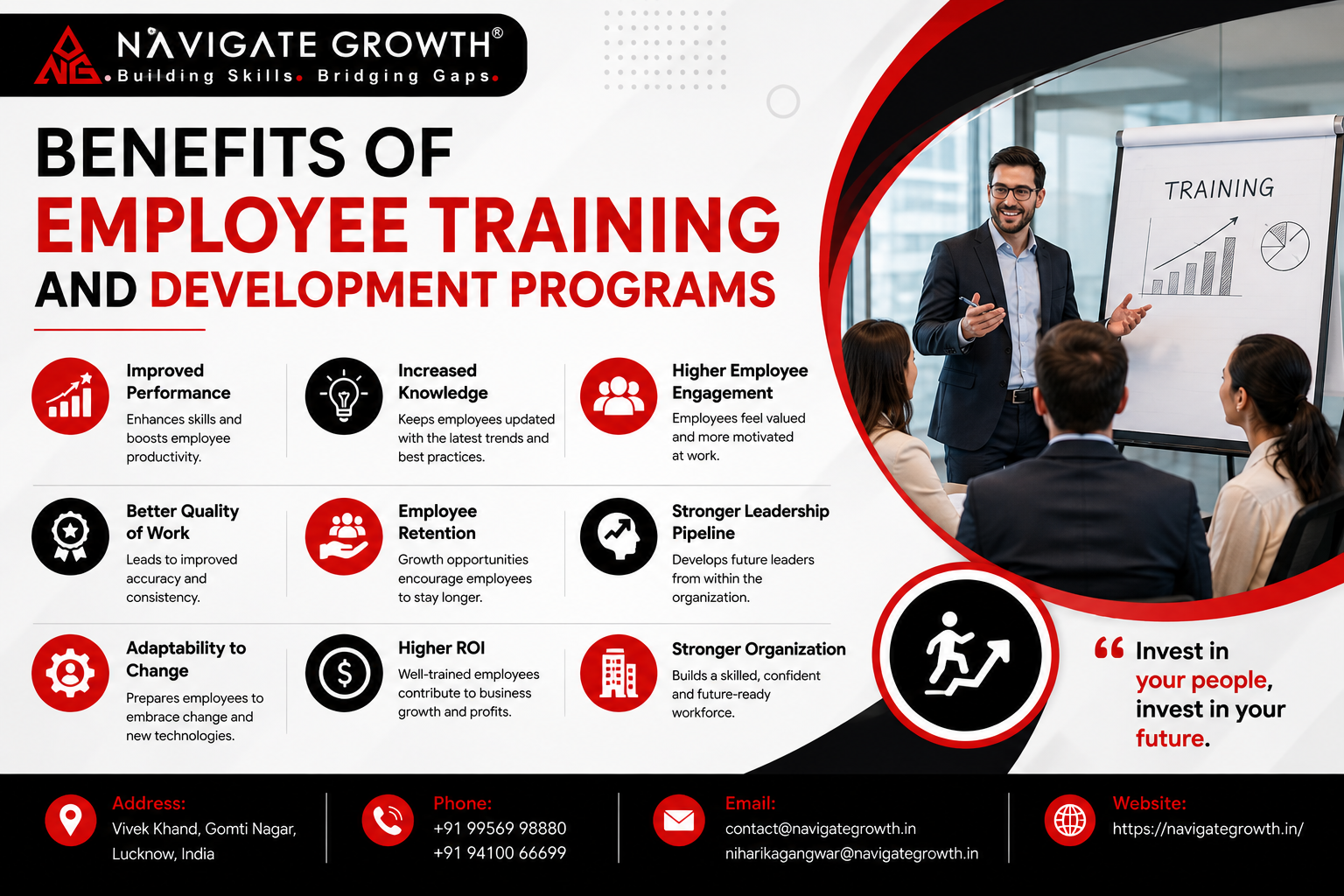
Implementing well-designed Employee Training and Development Programs delivers measurable benefits for both employees and organizations. Beyond improving technical skills, these programs strengthen workplace culture, encourage innovation, and support long-term business growth.
One of the biggest advantages is increased productivity. Employees who understand their responsibilities and possess the right skills complete tasks more accurately and efficiently. This leads to better operational performance and improved customer satisfaction.
Training also improves employee confidence. When employees receive regular learning opportunities, they become more comfortable handling complex tasks, solving problems, and making informed decisions. Increased confidence often translates into higher engagement and stronger workplace morale.
Another significant benefit is improved employee retention. Workers are more likely to stay with organizations that invest in their personal and professional growth. Reducing employee turnover saves recruitment costs while preserving valuable organizational knowledge.
Employee Training and Development Programs also encourage innovation. Employees exposed to new ideas, technologies, and industry best practices are more likely to identify opportunities for improvement and contribute creative solutions that drive business success.
Businesses also benefit from stronger teamwork. Communication, collaboration, and interpersonal skills training help employees work more effectively across departments, reducing misunderstandings and improving project outcomes.
Key Benefits of Employee Training and Development Programs
| Benefit | Business Impact |
|---|---|
| Improved productivity | Faster and higher-quality work |
| Better employee engagement | Increased motivation and commitment |
| Higher employee retention | Reduced hiring and onboarding costs |
| Stronger leadership | Better succession planning |
| Enhanced innovation | More creative problem-solving |
| Better customer satisfaction | Improved service quality |
| Improved compliance | Lower operational and legal risks |
| Career growth | Greater employee confidence and loyalty |
Organizations that continuously improve their Employee Training and Development Programs create an environment where employees feel empowered to learn, grow, and contribute their best. Instead of reacting to industry changes, these businesses stay ahead by building a workforce that is skilled, adaptable, and prepared for future opportunities.
Ultimately, Employee Training and Development Programs are not simply about teaching new skills—they are about creating a culture of continuous learning that benefits employees, customers, and the organization alike. Businesses that consistently invest in learning are better positioned to achieve sustainable growth, improve performance, and remain competitive in an ever-changing marketplace.
High-Impact Employee Training and Development Programs
Implementing the right Employee Training and Development Programs helps organizations improve employee performance, increase engagement, and achieve long-term business success. Modern businesses need a combination of technical, leadership, and workplace learning initiatives to build a future-ready workforce. Below are 11 high-impact programs that every organization should consider as part of its corporate training strategy.
1 Leadership Development Training
Leadership Development Training prepares employees and managers to lead teams effectively, make informed decisions, and solve business challenges. It focuses on communication, strategic thinking, coaching, delegation, and people management. This program builds future leaders, strengthens succession planning, and supports employee skill development. Strong leadership training improves team performance and contributes to sustainable business growth.
2 Communication Skills Training
Communication Skills Training enhances verbal, written, and interpersonal communication in the workplace. Employees learn active listening, presentation skills, professional writing, negotiation, and conflict management. Effective communication improves collaboration, reduces misunderstandings, and strengthens customer relationships. As one of the most valuable Employee Training and Development Programs, it creates a more connected and productive workforce.
3 Technical Skills Training
Technical Skills Training ensures employees remain updated with industry-specific tools, software, and technologies. It may include programming, cloud computing, data analysis, cybersecurity, automation, or machine operation depending on the organization. Continuous technical learning helps businesses remain competitive while improving productivity and operational efficiency. It is an essential workforce training solution in today’s digital economy.
4 Sales and Customer Service Training
Sales and Customer Service Training equips employees with techniques to understand customer needs, build relationships, handle objections, and improve customer satisfaction. Employees learn communication, persuasion, negotiation, and problem-solving skills that directly impact revenue growth. Organizations using these Employee Training and Development Programs often experience stronger customer loyalty and improved business performance.
5 Compliance and Workplace Safety Training
Compliance and Workplace Safety Training educates employees about workplace policies, labor laws, ethical conduct, cybersecurity, health regulations, and emergency procedures. This program reduces legal risks, prevents workplace accidents, and promotes a safe working environment. Regular compliance training also builds employee confidence and ensures organizations meet industry standards while maintaining operational excellence.
6 Digital Skills and AI Training
Digital Skills and AI Training has become one of the fastest-growing Employee Training and Development Programs due to rapid technological advancements. Employees learn artificial intelligence, digital collaboration tools, automation, cloud platforms, data analytics, and emerging technologies. These skills improve innovation, increase efficiency, and help organizations adapt successfully to digital transformation.
7 Diversity, Equity, and Inclusion (DEI) Training
DEI Training promotes a respectful, inclusive, and collaborative workplace where employees from diverse backgrounds feel valued. The program focuses on unconscious bias, cultural awareness, equal opportunity, inclusive leadership, and respectful communication. Organizations that invest in diversity training often benefit from stronger innovation, improved teamwork, higher employee engagement, and a positive workplace culture.
8 Time Management and Productivity Training
Time Management and Productivity Training helps employees prioritize tasks, manage workloads, reduce distractions, and improve efficiency. Participants learn goal setting, planning techniques, delegation, and productivity tools that support better performance. This workplace learning program enables employees to complete projects on time while maintaining work quality and reducing stress.
9 Team Building and Collaboration Training
Team Building and Collaboration Training strengthens relationships between employees by improving communication, trust, and cooperation. Activities include group problem-solving, collaborative projects, workshops, and team exercises. Effective collaboration enhances creativity, increases productivity, and supports cross-functional teamwork. As part of comprehensive Employee Training and Development Programs, this training creates a stronger organizational culture.
10 Project Management Training
Project Management Training develops employees’ abilities to plan, execute, monitor, and successfully complete projects. Topics include project planning, budgeting, scheduling, resource allocation, risk management, and stakeholder communication. Employees also become familiar with modern project management methodologies and digital collaboration tools. Well-trained project teams improve efficiency, reduce delays, and deliver better business results.
11 Emotional Intelligence and Conflict Resolution Training
Emotional Intelligence and Conflict Resolution Training helps employees recognize emotions, manage workplace stress, build empathy, and resolve conflicts professionally. The program improves interpersonal relationships, leadership effectiveness, decision-making, and employee engagement. Organizations benefit from healthier workplace relationships, improved collaboration, and stronger team performance, making it one of the most valuable Employee Training and Development Programs for long-term organizational success.
How to Choose the Right Employee Training and Development Programs
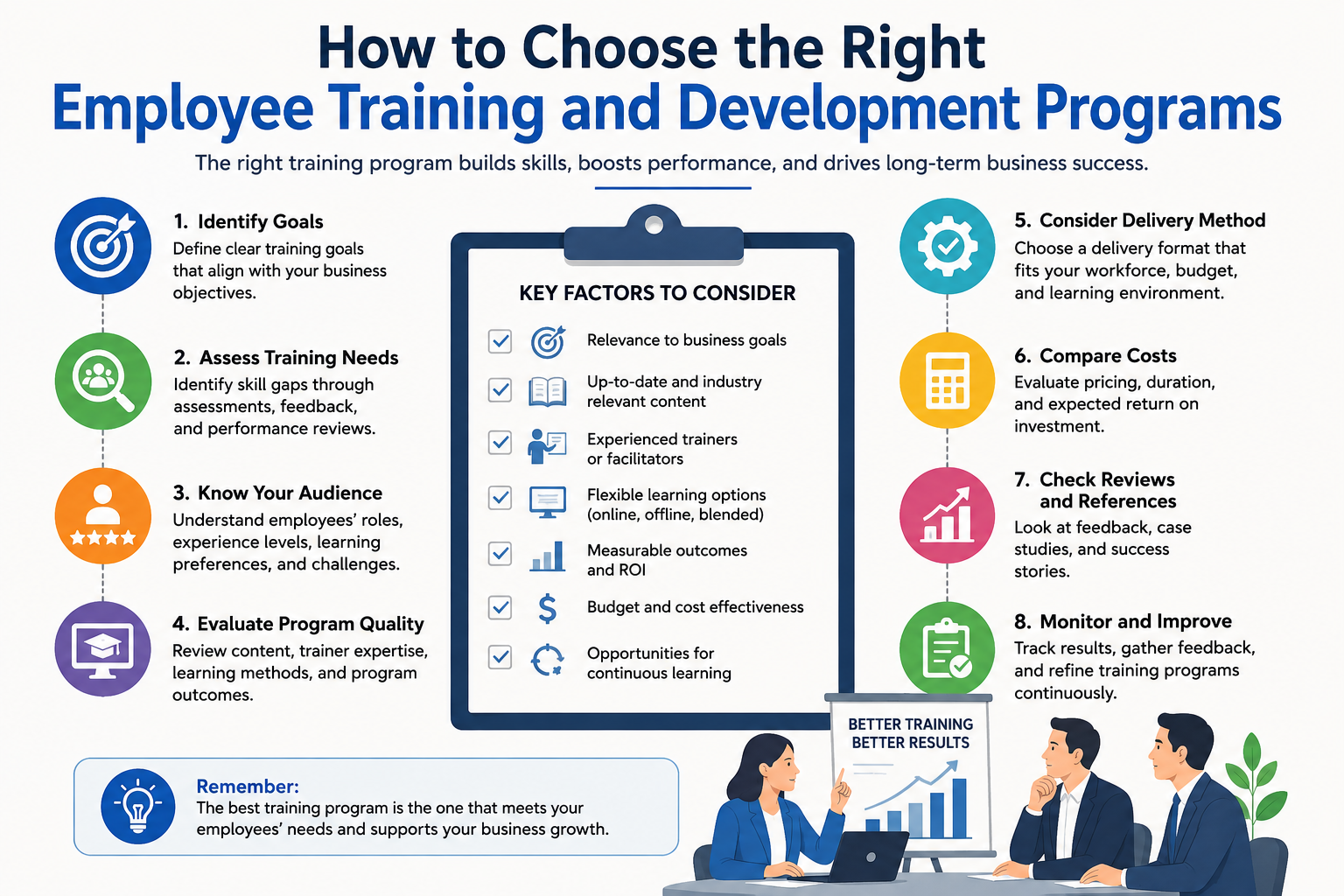
Selecting the right Employee Training and Development Programs is essential for improving employee performance and achieving business goals. Every organization has unique training needs, so the program should align with company objectives, workforce skills, and future growth plans.
Start by identifying skill gaps through performance reviews, employee feedback, and business assessments. Once the gaps are identified, choose programs that address technical, leadership, communication, or compliance requirements. The training method also matters. Organizations can select classroom sessions, online courses, workshops, coaching, mentoring, or blended learning based on employee preferences and business requirements.
It is equally important to evaluate the trainer’s expertise, course content, and learning outcomes before implementation. Regular feedback and continuous improvement ensure that training remains relevant as business needs evolve.
Factors to Consider
| Factor | Why It Matters |
|---|---|
| Business Goals | Aligns training with company objectives |
| Skill Gap Analysis | Identifies learning priorities |
| Learning Format | Improves employee participation |
| Budget | Ensures cost-effective training |
| Trainer Expertise | Delivers quality learning experiences |
| Performance Tracking | Measures long-term impact |
By choosing the right Employee Training and Development Programs, organizations can maximize employee engagement, productivity, and return on investment.
Common Mistakes to Avoid
Many organizations invest in training but fail to achieve expected results because of poor planning or execution. Avoiding common mistakes helps improve learning effectiveness and employee development.
One of the biggest mistakes is providing the same training to every employee regardless of their role or experience. Training should always be customized to specific job requirements.
Another mistake is treating training as a one-time activity. Continuous learning is far more effective than a single workshop because employees need regular practice and updates.
Organizations also make the mistake of ignoring employee feedback. Listening to participants helps improve future training sessions and increases engagement.
Finally, many companies fail to measure outcomes. Without evaluating results, it becomes difficult to understand whether Employee Training and Development Programs are improving business performance.
Common Mistakes
- Ignoring skill gap assessments.
- Selecting outdated training content.
- Lack of management support.
- Poor employee engagement.
- No follow-up learning sessions.
- Not measuring training effectiveness.
- Focusing only on technical skills while ignoring soft skills.
Avoiding these mistakes helps organizations build a stronger learning culture and achieve better business outcomes.
How to Measure Training Success
Measuring the effectiveness of Employee Training and Development Programs ensures that learning investments produce measurable business results. Organizations should evaluate both employee performance and business impact after training.
Performance indicators may include productivity improvements, quality of work, customer satisfaction, employee engagement, and retention rates. Pre-training and post-training assessments also help measure knowledge improvement.
Managers should gather employee feedback through surveys, interviews, and performance reviews. Monitoring workplace behavior after training provides valuable insights into whether employees are applying newly acquired skills.
Key Performance Indicators (KPIs)
| KPI | Measurement |
|---|---|
| Employee Productivity | Output before and after training |
| Knowledge Assessment | Test scores and certifications |
| Employee Engagement | Survey results |
| Customer Satisfaction | Feedback and service ratings |
| Employee Retention | Turnover reduction |
| Business Performance | Revenue, quality, and efficiency improvements |
Regular evaluation allows organizations to improve future Employee Training and Development Programs and maximize return on investment.
Future Trends in Employee Training and Development Programs
Technology continues to reshape workplace learning, making Employee Training and Development Programs more personalized, interactive, and accessible than ever before.
Artificial Intelligence is helping organizations deliver customized learning experiences based on employee performance and career goals. Microlearning is becoming increasingly popular because employees can learn through short, focused lessons that fit into busy schedules.
Virtual Reality (VR) and Augmented Reality (AR) are transforming practical training by providing realistic simulations for industries such as healthcare, manufacturing, and customer service.
Organizations are also investing in continuous learning platforms, mobile learning, gamification, and data-driven learning analytics to improve engagement and measure progress more effectively.
As businesses continue adopting digital transformation, future Employee Training and Development Programs will focus on AI skills, leadership development, cybersecurity, emotional intelligence, and continuous upskilling to prepare employees for evolving workplace demands.
Frequently Asked Questions
1. What are Employee Training and Development Programs?
They are structured learning initiatives that improve employees’ knowledge, skills, performance, and career growth while supporting organizational success.
2. Why are Employee Training and Development Programs important?
They increase productivity, improve employee engagement, reduce skill gaps, strengthen leadership, and help organizations remain competitive.
3. How often should employee training be conducted?
Most organizations provide onboarding training, annual compliance training, and continuous learning throughout the year based on business needs.
4. Which training program is most beneficial?
The best program depends on organizational goals, but leadership, technical skills, communication, compliance, and digital skills training are among the most valuable.
5. How can businesses measure training effectiveness?
Organizations can evaluate productivity, employee performance, engagement, customer satisfaction, retention rates, and post-training assessments.
Conclusion
Investing in Employee Training and Development Programs is one of the most effective ways to build a skilled, motivated, and future-ready workforce. From leadership development and technical training to communication, compliance, and digital learning, every program contributes to stronger employee performance and long-term business growth.
Organizations that regularly assess skill gaps, implement relevant corporate training programs, measure learning outcomes, and embrace emerging technologies create a culture of continuous improvement. By making employee development a strategic priority, businesses can increase productivity, improve employee engagement, strengthen customer satisfaction, and achieve sustainable success in an increasingly competitive business environment.
Contact Navigate Growth
Navigate Growth
Address: Vivek Khand, Gomti Nagar, Lucknow, India
Phone:
📞 +91 99569 98880
📞 +91 94100 66699
Email:
✉️ contact@navigategrowth.in
✉️ niharikagangwar@navigategrowth.in
Website:
🌐 https://navigategrowth.in/
Instagram:
📷 https://www.instagram.com/thegrowthmindset.official/
Connect with Navigate Growth for professional employee training and development programs, leadership development programs, and corporate training solutions designed to improve workforce skills and business performance.