
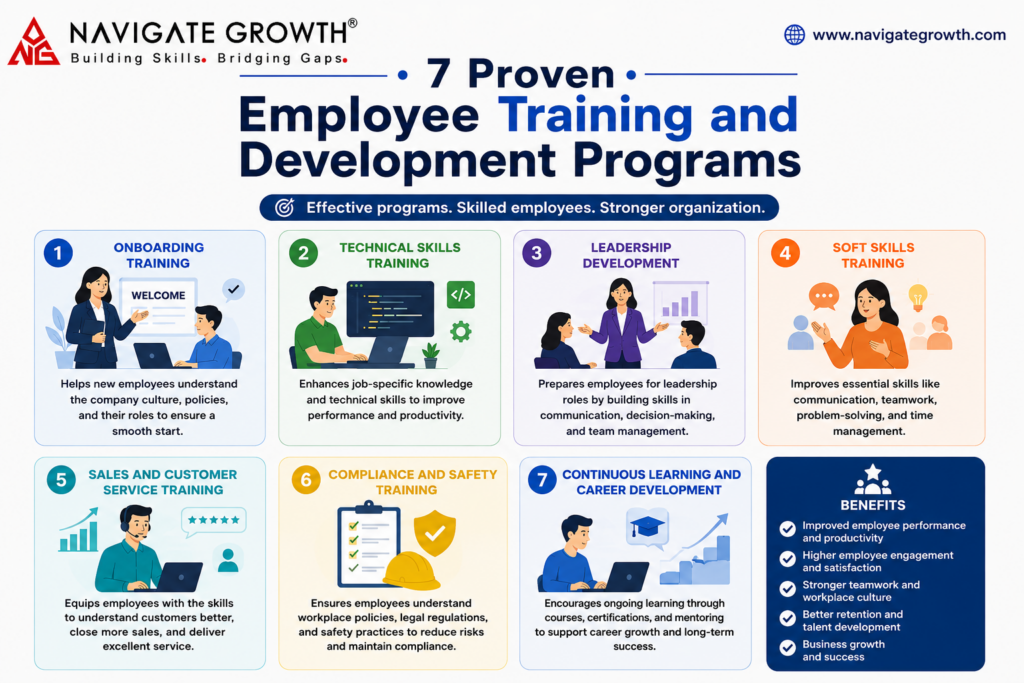
7 Proven Employee Training and Development Programs
In today’s competitive business environment, organizations cannot rely solely on hiring talented individuals. To remain productive, innovative, and competitive, companies must continuously invest in employee training and development programs. These programs help employees strengthen existing skills, learn new competencies, improve performance, and prepare for future responsibilities.
Businesses that prioritize employee growth often experience higher productivity, better employee retention, stronger workplace culture, and improved customer satisfaction. Whether you run a small business or a large corporation, implementing effective employee training and development programs can significantly impact organizational success.
This guide explores seven proven training and development programs that help employees grow professionally while contributing to long-term business goals.
What Are Employee Training and Development Programs?
Employee training and development programs are structured initiatives designed to improve employee knowledge, skills, and performance.
While training focuses on enhancing current job-related skills, development prepares employees for future opportunities and leadership roles. Employee training and development programs are structured learning initiatives designed to improve employees’ knowledge, skills, and overall job performance. Training focuses on helping employees perform their current roles more effectively by teaching job-specific skills, processes, and tools. Development, on the other hand, prepares employees for future responsibilities, leadership roles, and long-term career growth. These programs may include workshops, online courses, mentoring, coaching, certifications, and hands-on learning experiences. Effective employee training and development programs help organizations build a skilled workforce, increase productivity, improve employee engagement, and ensure employees are prepared to meet changing business and industry demands.
Training Focuses On:
- Job-specific skills
- Technical knowledge
- Compliance requirements
- Process improvement
- Productivity enhancement
Development Focuses On:
- Leadership growth
- Career advancement
- Strategic thinking
- Communication skills
- Long-term professional success
Together, these initiatives create a workforce capable of adapting to change and supporting business growth.
Why Employee Training and Development Programs Matter
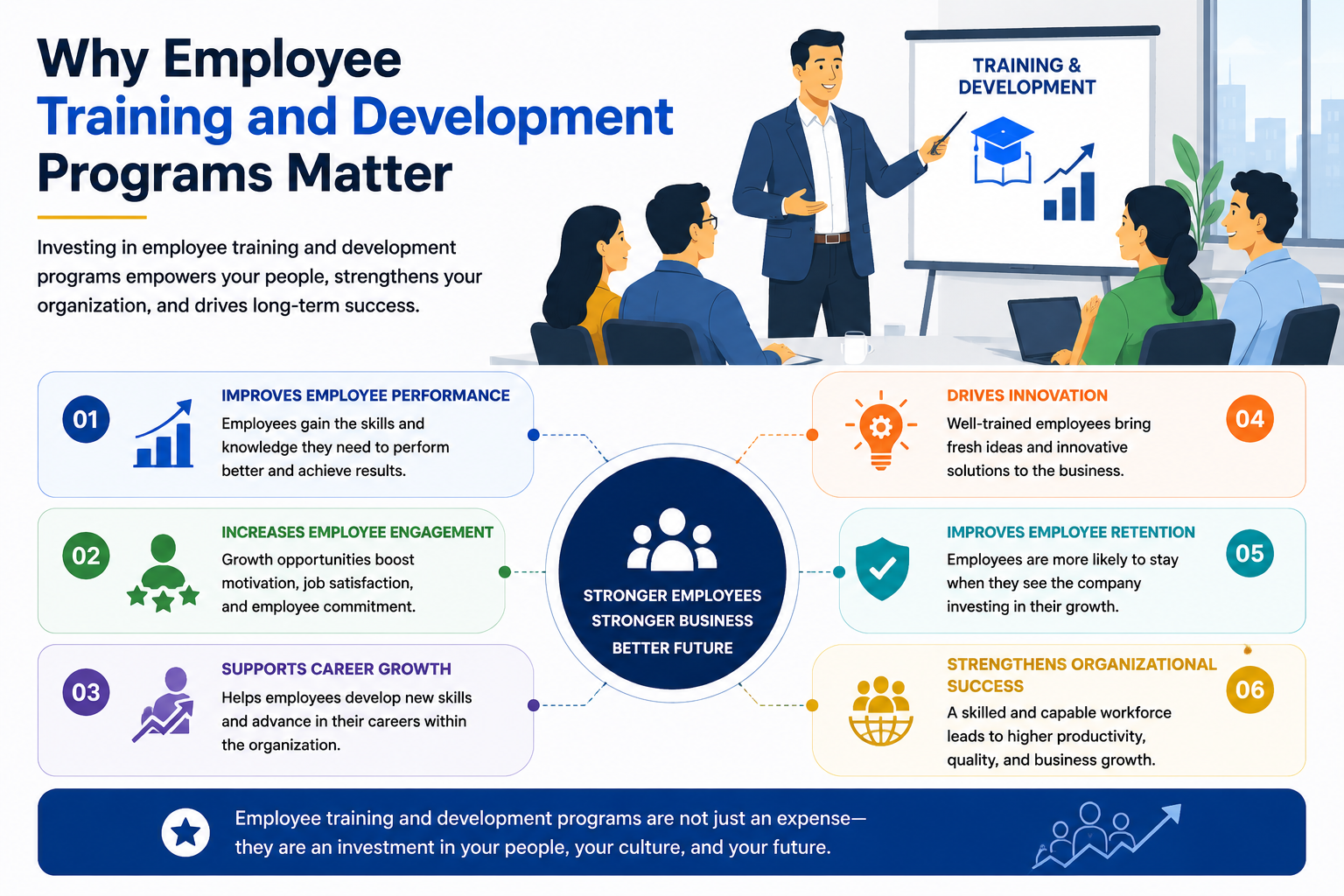
Employee training and development programs are essential for improving workforce performance and supporting business growth. They help employees gain new skills, increase productivity, and stay updated with industry changes. Well-trained employees perform their jobs more efficiently, make fewer mistakes, and contribute to better customer satisfaction. These programs also boost employee confidence, engagement, and job satisfaction, leading to higher retention rates. Additionally, development initiatives prepare employees for future leadership roles, ensuring a strong talent pipeline within the organization. By investing in continuous learning, businesses can remain competitive, adapt to change, and build a skilled, motivated, and future-ready workforce.
Many organizations view training as an expense. However, successful businesses recognize it as an investment that generates measurable returns.
Benefits of Employee Training and Development Programs
Increased Productivity
Employees perform tasks more efficiently when they understand processes, tools, and expectations.
Higher Employee Retention
Workers are more likely to stay with companies that invest in their growth.
Improved Employee Engagement
Training opportunities make employees feel valued and motivated.
Better Customer Satisfaction
Well-trained employees deliver superior service and resolve issues effectively.
Stronger Leadership Pipeline
Development programs prepare future managers and leaders.
Greater Adaptability
Continuous learning helps organizations respond to market changes and technological advancements.
1. Onboarding and Orientation Programs
A strong onboarding process lays the foundation for employee success.
Many organizations underestimate the importance of onboarding. New hires often struggle when they receive limited guidance during their first few weeks.
Effective onboarding programs introduce employees to:
- Company culture
- Organizational goals
- Policies and procedures
- Job responsibilities
- Team members
- Technology systems
Benefits of Onboarding Programs
- Faster employee integration
- Reduced turnover
- Improved confidence
- Better productivity
- Stronger engagement
Best Practices
- Create a structured onboarding plan.
- Assign mentors to new hires.
- Provide training resources immediately.
- Schedule regular check-ins.
Employees who receive proper onboarding are more likely to become productive quickly and remain with the organization longer.
2. Technical Skills Training Programs
Technical training is one of the most important employee training and development programs in modern workplaces.
Technology evolves rapidly, and employees must continuously update their skills to remain effective.
Areas Covered
- Software applications
- Data analysis
- Programming languages
- Machinery operation
- Industry-specific tools
- Digital platforms
Advantages of Technical Training
Improved Efficiency
Employees complete tasks faster and more accurately.
Reduced Errors
Training minimizes costly mistakes.
Increased Innovation
Employees can leverage technology effectively.
Better Competitiveness
Organizations stay ahead of industry trends.
Effective Delivery Methods
- Online courses
- Virtual workshops
- Hands-on practice
- Simulation exercises
- Certification programs
Technical skills training ensures employees remain productive in an increasingly digital workplace.
3. Leadership Development Programs
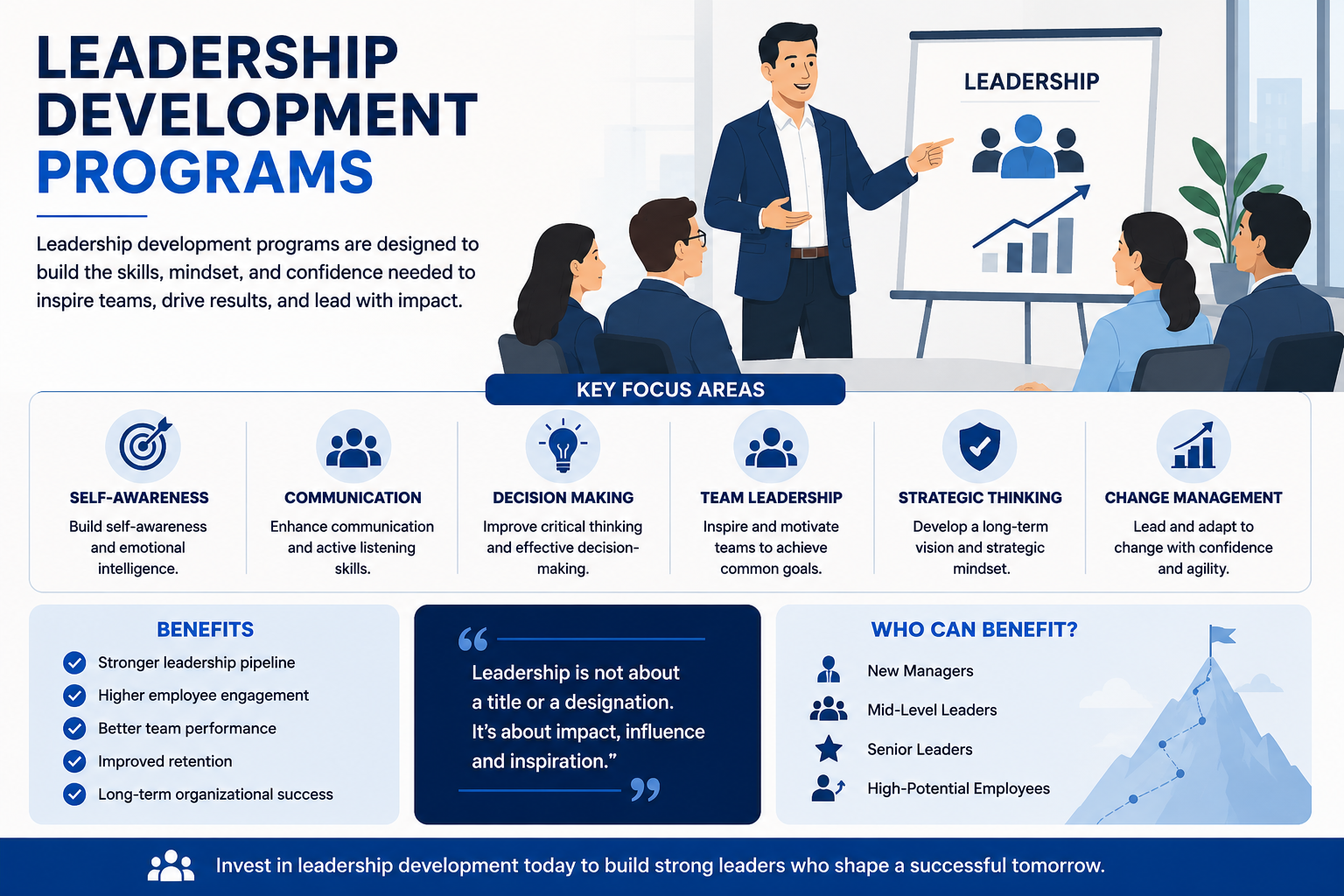
Organizations need future leaders who can guide teams, manage change, and drive results.
Leadership development is among the most valuable employee training and development programs because it prepares employees for greater responsibilities.
Leadership Skills Covered
- Decision-making
- Conflict resolution
- Strategic planning
- Communication
- Team management
- Emotional intelligence
Why Leadership Development Matters
Many companies struggle when experienced leaders retire or leave. Leadership training creates a pipeline of qualified internal candidates.
Benefits
- Improved succession planning
- Stronger organizational culture
- Increased employee morale
- Better team performance
- Enhanced innovation
Common Leadership Development Activities
- Executive coaching
- Mentorship programs
- Leadership workshops
- Job shadowing
- Management simulations
Organizations that develop leaders internally often experience smoother transitions and stronger long-term performance.
4. Soft Skills Training Programs
Technical expertise alone does not guarantee success.
Employees also need interpersonal skills that enable effective collaboration and communication.
Soft skills training focuses on:
- Communication
- Teamwork
- Time management
- Problem-solving
- Critical thinking
- Adaptability
Importance of Soft Skills
Employees interact with customers, colleagues, vendors, and stakeholders daily.
Strong interpersonal skills improve workplace relationships and organizational effectiveness.
Benefits
- Better collaboration
- Improved customer service
- Reduced workplace conflicts
- Stronger teamwork
- Higher productivity
Popular Soft Skills Training Methods
- Group workshops
- Role-playing exercises
- Interactive discussions
- Coaching sessions
- Team-building activities
Soft skills often determine whether employees can successfully apply their technical expertise in real-world situations.
5. Compliance and Workplace Safety Training
Every organization must ensure employees understand workplace regulations and safety requirements.
Compliance training protects businesses from legal risks and promotes a secure work environment.
Topics Covered
- Workplace safety
- Data privacy
- Cybersecurity
- Harassment prevention
- Industry regulations
- Ethical conduct
Benefits
Reduced Legal Risks
Employees understand company policies and legal obligations.
Enhanced Workplace Safety
Training minimizes accidents and injuries.
Better Risk Management
Organizations avoid costly compliance violations.
Stronger Corporate Reputation
Ethical behavior builds trust among customers and stakeholders.
Best Practices
- Conduct regular refresher training.
- Use real-world scenarios.
- Track completion rates.
- Assess employee understanding.
Compliance training is not optional; it is essential for organizational protection and sustainability.
6. Cross-Training Programs
Cross-training teaches employees skills outside their primary job responsibilities.
This approach creates a more flexible and resilient workforce.
Examples
- Customer service representatives learning sales processes
- Administrative staff understanding project management
- Operations employees learning inventory management
Benefits
Increased Flexibility
Employees can fill gaps when colleagues are unavailable.
Better Collaboration
Teams gain a broader understanding of business operations.
Improved Problem-Solving
Employees see challenges from multiple perspectives.
Career Growth Opportunities
Workers develop diverse skills.
How to Implement Cross-Training
- Rotate job responsibilities.
- Encourage knowledge sharing.
- Create mentorship opportunities.
- Develop structured learning plans.
Cross-training helps organizations maintain continuity during unexpected disruptions.
7. Continuous Learning and Career Development Programs
Continuous learning and career development programs help employees improve their skills and advance their careers through ongoing education and training opportunities. These programs encourage employees to stay updated with industry trends, new technologies, and changing job requirements. Organizations may offer online courses, workshops, certifications, mentoring, and career coaching to support professional growth. By investing in continuous learning, companies create a culture of improvement and innovation. Employees become more confident, adaptable, and prepared for future responsibilities. As a result, businesses benefit from higher productivity, better employee retention, stronger leadership development, and a workforce that is ready for long-term success.
The most successful organizations foster a culture of lifelong learning.
Continuous learning programs encourage employees to pursue ongoing professional growth.
Components
- Online learning platforms
- Industry certifications
- Professional workshops
- Educational reimbursements
- Career coaching
Why Continuous Learning Matters
The skills required today may become outdated tomorrow.
Organizations that support continuous learning remain adaptable and competitive.
Benefits
- Increased innovation
- Better employee retention
- Enhanced adaptability
- Improved performance
- Stronger organizational resilience
Creating a Learning Culture
- Reward learning achievements.
- Provide access to educational resources.
- Encourage knowledge sharing.
- Support career development goals.
Continuous learning transforms organizations into knowledge-driven workplaces.
How to Choose the Right Employee Training and Development Programs
Choosing the right employee training and development programs starts with identifying your organization’s goals and employee skill gaps. Assess current performance levels, gather feedback from managers, and determine the skills employees need to succeed. Select training methods that match both business objectives and learning preferences, such as workshops, online courses, mentoring, or hands-on training. Effective employee training and development programs should be practical, measurable, and aligned with long-term growth plans. It is also important to regularly evaluate training outcomes and update programs as business needs evolve. A well-planned approach ensures better employee performance and organizational success.
Not every program fits every organization.
Before investing in training, companies should evaluate their specific needs.
Step 1: Identify Skill Gaps
Analyze employee performance and business objectives.
Step 2: Define Goals
Determine what outcomes the training should achieve.
Step 3: Select Appropriate Methods
Choose workshops, online courses, coaching, or blended learning.
Step 4: Measure Results
Track performance improvements and business impact.
Step 5: Continuously Improve
Update training programs based on feedback and changing needs.
Common Challenges in Employee Training Programs
Lack of Employee Engagement
Solution:
- Use interactive learning methods.
- Personalize training content.
Limited Budget
Solution:
- Utilize online learning platforms.
- Prioritize high-impact training initiatives.
Time Constraints
Solution:
- Implement microlearning modules.
- Offer flexible learning schedules.
Difficulty Measuring Results
Solution:
- Establish clear performance metrics.
- Monitor progress consistently.
Addressing these challenges improves training effectiveness and return on investment.
Measuring the Success of Employee Training and Development Programs
Organizations should evaluate training effectiveness regularly.
Key Metrics
- Employee productivity
- Training completion rates
- Employee retention
- Customer satisfaction
- Performance improvements
- Internal promotions
Evaluation Methods
- Surveys
- Performance reviews
- Skills assessments
- Manager feedback
- Business outcome analysis
Tracking these metrics ensures continuous improvement and demonstrates the value of training investments.
Future Trends in Employee Training and Development Programs
The future of employee training and development programs is driven by AI-powered learning, microlearning, mobile training, and virtual reality tools. These modern methods make learning more flexible, engaging, and personalized, helping employees develop new skills quickly and adapt to changing workplace needs.
Workplace learning continues to evolve rapidly.
Emerging Trends
Artificial Intelligence-Based Learning
Personalized learning experiences based on employee needs.
Microlearning
Short training sessions designed for busy professionals.
Virtual Reality Training
Immersive simulations for skill development.
Mobile Learning
Access training anytime and anywhere.
Data-Driven Development
Learning strategies informed by performance analytics.
Organizations that embrace these trends can build stronger and more agile workforces.
The Importance of a Learning Culture in the Workplace
A strong learning culture encourages employees to continuously improve their skills and knowledge. Organizations that promote learning create an environment where employees feel motivated to grow professionally. This culture increases innovation, adaptability, and employee engagement while helping businesses remain competitive in a rapidly changing market.
How Employee Training and Development Programs Improve Retention
Employees are more likely to stay with organizations that invest in their growth. Effective employee training and development programs demonstrate a company’s commitment to career advancement and professional success. This reduces turnover, lowers hiring costs, and helps businesses retain valuable talent.
The Role of Managers in Employee Development
Managers play a crucial role in the success of employee training and development programs. They identify skill gaps, provide coaching, monitor progress, and encourage continuous learning. Supportive managers help employees apply new skills effectively, leading to better performance and career growth.
Measuring the ROI of Employee Training and Development Programs
Organizations should evaluate the effectiveness of employee training and development programs by measuring productivity improvements, employee retention, customer satisfaction, and overall business performance. Tracking these metrics helps determine whether training investments are delivering measurable returns.
Common Mistakes to Avoid in Employee Training Programs
Many organizations fail to achieve training goals because they provide generic content, ignore employee feedback, or lack clear objectives. Successful employee training and development programs should be tailored to business needs, regularly updated, and supported by measurable outcomes.
How Technology Is Transforming Employee Training
Technology has revolutionized employee training and development programs through online learning platforms, artificial intelligence, mobile learning apps, and virtual reality simulations. These tools make training more accessible, engaging, and effective for modern employees.
Benefits of Personalized Employee Training Programs
Personalized employee training and development programs focus on individual learning needs, career goals, and skill levels. This approach increases engagement, improves learning outcomes, and helps employees develop competencies that directly contribute to organizational success.
Building a Long-Term Employee Development Strategy
A long-term strategy ensures that employee training and development programs align with business objectives and future workforce needs. By continuously investing in employee growth, organizations can create a skilled, motivated, and future-ready workforce.
Conclusion
Employee training and development programs are essential for building a skilled, motivated, and future-ready workforce. From onboarding and technical skills training to leadership development and continuous learning, each program plays a critical role in organizational success.
Companies that invest in employee growth experience higher productivity, stronger retention, improved engagement, and greater competitiveness. By implementing these seven proven programs, organizations can create a culture of learning that benefits both employees and business performance.
The future belongs to companies that prioritize continuous improvement, and effective employee training and development programs are the foundation of that success.
Frequently Asked Questions (FAQs)
1. How often should employee training programs be updated?
Training programs should be reviewed at least annually. However, industries experiencing rapid technological or regulatory changes may require updates every few months to keep employees informed and competitive.
2. What is the difference between employee training and employee development?
Training focuses on improving skills needed for current job performance, while development prepares employees for future roles, leadership opportunities, and long-term career growth.
3. How can small businesses implement employee training on a limited budget?
Small businesses can use online learning platforms, internal mentoring programs, webinars, and knowledge-sharing sessions to provide cost-effective training opportunities.
4. What role do managers play in employee development?
Managers identify skill gaps, provide coaching, support career planning, monitor progress, and encourage continuous learning within their teams.
5. Can employee training improve company culture?
Yes. Effective training encourages collaboration, communication, accountability, and professional growth, all of which contribute to a stronger workplace culture.
6. What are the signs that employees need additional training?
Common indicators include declining productivity, increased errors, customer complaints, skill gaps, low engagement, and difficulty adapting to new technologies.
7. How do employee development programs support succession planning?
Development programs prepare high-potential employees for leadership roles, ensuring smooth transitions when key positions become vacant.
8. What industries benefit most from employee training and development programs?
Every industry benefits, including healthcare, manufacturing, technology, retail, finance, education, logistics, and professional services.
9. How can organizations encourage employees to participate in training?
Organizations can offer career advancement opportunities, recognize achievements, provide incentives, and align learning with employee goals.
10. What is the long-term impact of employee training and development programs?
Long-term benefits include stronger employee retention, improved productivity, enhanced innovation, better leadership capabilities, and sustainable business growth.
 Contact Us
 Address:
 Email:
 Phone:
 Website: