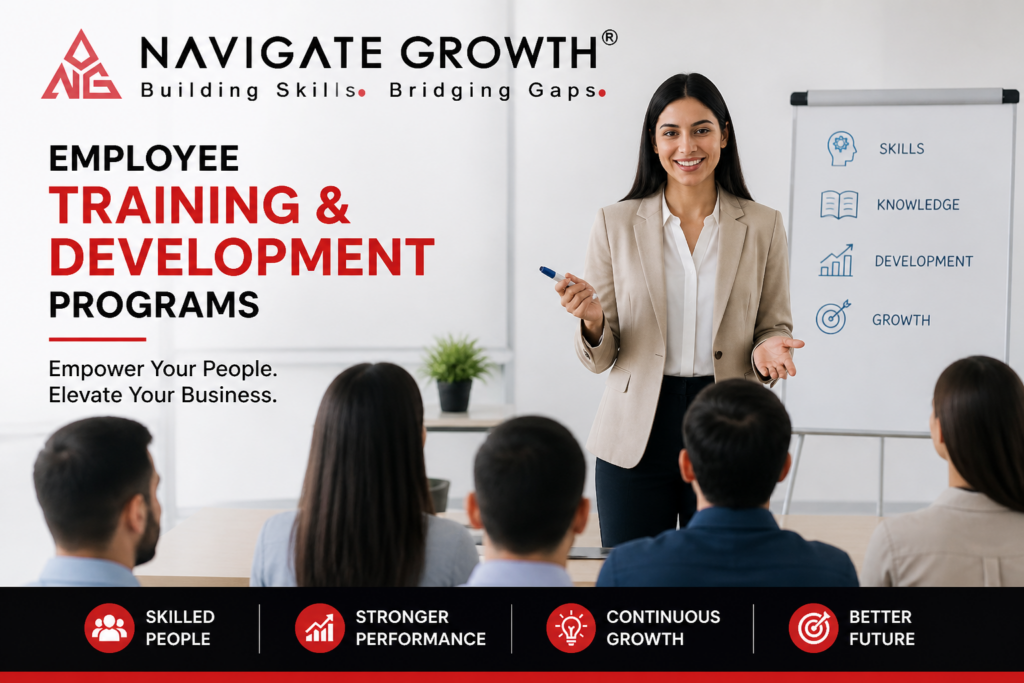
Employee Training and Development Programs: Complete B2B Guide for 2026
Employee Training and Development Programs for 2026. Improve skills, boost productivity and ROI with Navigate Growth training.
Introduction: Why Every Business Needs Employee Training and Development Programs

In today’s rapidly evolving business landscape, organizations are facing constant pressure to stay competitive, innovative, and efficient. Hiring skilled employees is no longer enough. Companies must continuously upgrade their workforce to match industry demands. This is where Employee Training and Development Programs play a crucial role.
With technology advancing at a fast pace, job roles are changing, and skill requirements are evolving. Employees need regular upskilling to remain relevant. At the same time, businesses need high-performing teams to achieve growth and profitability. A well-designed Employee Training and Development Programs strategy bridges this gap effectively.
For B2B companies, especially in India, workforce development is directly linked to business success. Organizations that invest in structured training programs experience better productivity, improved employee retention, and stronger leadership pipelines. Many forward-thinking companies are now partnering with Navigate Growth to implement customized Employee Training and Development Programs that deliver measurable business results.
If you are an HR manager, learning and development head, or business owner, understanding how to design and implement effective training programs can significantly impact your organization’s performance.
What are Employee Training and Development Programs?
Employee Training and Development Programs are structured initiatives designed to improve the knowledge, skills, and capabilities of employees. These programs help align employee performance with business goals while preparing them for future responsibilities.
Key Elements of Effective Programs
A successful program includes multiple components that work together to create a strong learning environment:
- Technical skill development for job-specific roles
- Soft skills training such as communication and teamwork
- Leadership development initiatives
- Continuous learning opportunities
- Performance monitoring and feedback systems
- Personalized learning paths for employees
Difference Between Training and Development
While both terms are often used together, they serve different purposes:
- Training focuses on improving current job performance
- Development focuses on preparing employees for future roles
A strong Employee Training and Development Programs strategy combines both aspects to ensure both short-term efficiency and long-term growth.
Importance of Employee Training and Development Programs in 2026
The importance of Employee Training and Development Programs has increased significantly due to changing workplace dynamics. Businesses today operate in a fast-paced, technology-driven environment where adaptability is key.
Key Reasons Why Training is Critical
- Rapid Technological Advancements
New tools, software, and automation are transforming industries. Employees must continuously learn to stay relevant. - Changing Workforce Expectations
Modern employees expect opportunities for growth and career development. Companies that fail to provide this risk losing top talent. - Hybrid Work Environment
Remote and hybrid work models require new communication and collaboration skills. - Increased Competition
Businesses need highly skilled teams to outperform competitors in the market.
Shift Towards Continuous Learning
Traditional one-time training programs are no longer effective. Organizations are now adopting continuous learning models where employees are regularly trained and updated. This approach ensures that skills remain relevant and performance continues to improve.
Role of HR Training Strategies
Modern HR training strategies focus on aligning employee development with business objectives. Companies are using data and analytics to measure training effectiveness and improve outcomes.
Key Benefits for Businesses (B2B Focus)

Implementing structured Employee Training and Development Programs provides several advantages for businesses.
1. Increased Productivity
When employees are well-trained, they perform tasks more efficiently and with greater accuracy. This leads to improved overall productivity and better business outcomes.
2. Higher Employee Retention
Employees are more likely to stay with organizations that invest in their growth. Training programs show that the company values its workforce, which increases loyalty.
3. Improved Employee Engagement
Learning opportunities keep employees motivated and engaged. Engaged employees are more productive and contribute positively to the organization.
4. Strong Leadership Pipeline
Leadership training programs help identify and develop future leaders within the organization. This ensures smooth succession planning and long-term stability.
5. Better Financial Performance
Businesses that invest in workforce training solutions often see improved profitability. Skilled employees make fewer mistakes and contribute more effectively to business goals.
6. Competitive Advantage
Companies with strong Employee Training and Development Programs stand out in the market. They are better equipped to handle challenges and adapt to changes.
Types of Employee Training and Development Programs
To build a comprehensive strategy, businesses must implement different types of Employee Training and Development Programs.
1. Onboarding Programs
Onboarding training helps new employees understand company culture, processes, and expectations. A strong onboarding program ensures that employees become productive quickly.
2. Technical Training Programs
These programs focus on job-specific skills required for daily tasks. They are essential for maintaining efficiency and accuracy in operations.
3. Soft Skills Training
Soft skills such as communication, teamwork, and problem-solving are critical for workplace success. These programs improve collaboration and employee relationships.
4. Leadership Training Programs
Leadership programs prepare employees for managerial roles. They focus on decision-making, team management, and strategic thinking.
5. Compliance Training
Compliance training ensures that employees follow legal requirements and company policies. It helps reduce risks and maintain a safe work environment.
6. Digital and Technology Training
As businesses adopt digital tools and automation, employees must learn how to use new technologies effectively. Digital training programs ensure smooth transitions.
Step-by-Step Guide to Build Employee Training and Development Programs
Creating effective Employee Training and Development Programs requires careful planning and execution.
Step 1: Identify Skill Gaps
The first step is to understand what skills employees currently have and what skills are needed in the future.
How to Identify Gaps
- Conduct employee assessments
- Review performance data
- Gather feedback from managers
- Analyze business goals
This step ensures that training programs address real business needs.
Step 2: Set Clear Training Objectives
Once skill gaps are identified, the next step is to define clear objectives.
Examples of Objectives
- Improve employee productivity by 20%
- Enhance communication skills across teams
- Develop leadership capabilities
Clear goals help measure the success of Employee Training and Development Programs.
Step 3: Choose the Right Training Methods
Selecting the right training methods is crucial for effectiveness.
Common Training Methods
- Instructor-led workshops
- Online learning platforms
- On-the-job training
- Group discussions and activities
The choice of method depends on the type of skills being developed.
Step 4: Develop Training Content
Training content should be relevant, engaging, and practical.
Best Practices
- Use real-life examples
- Include interactive activities
- Focus on practical application
- Customize content based on industry
Well-designed content increases learning effectiveness.
Step 5: Implement the Training Programs
After planning and development, the next critical step is execution. Even the best-designed Employee Training and Development Programs can fail if implementation is weak.
Best Practices for Implementation
- Schedule training sessions at convenient times
- Ensure participation from all relevant employees
- Use engaging formats like discussions, activities, and real-life scenarios
- Provide access to learning resources and materials
- Encourage interaction and feedback during sessions
A smooth implementation ensures that employees actively participate and gain maximum value from the training.
Step 6: Measure Training Effectiveness
Measuring the success of Employee Training and Development Programs is essential to understand their impact on business performance.
Key Metrics to Track
- Employee performance improvement
- Productivity levels
- Employee engagement scores
- Retention rates
- Return on investment (ROI)
Evaluation Methods
- Feedback surveys
- Performance reviews
- Skill assessments
- Manager evaluations
Continuous evaluation helps organizations refine their training strategies and improve outcomes.
Latest Trends in Employee Training and Development Programs
As businesses evolve, Employee Training and Development Programs are also transforming to meet new demands. Organizations are adopting innovative approaches to improve learning effectiveness.
1. AI-Powered Learning
Artificial intelligence is enabling personalized learning experiences. Employees receive training based on their individual performance, strengths, and weaknesses.
2. Microlearning
Microlearning focuses on delivering content in short, focused modules. This approach improves retention and makes learning more flexible.
3. Gamification
Gamified training uses elements like points, rewards, and challenges to make learning engaging and interactive.
4. Hybrid Learning Models
Organizations are combining online and offline training methods to provide flexibility and better learning experiences.
5. Data-Driven Learning
Analytics tools help track employee progress and identify areas for improvement. This makes Employee Training and Development Programs more effective and results-driven.
Challenges in Employee Training and Development Programs & Solutions
While training programs offer many benefits, organizations often face challenges in implementation.
Challenge 1: Low Employee Engagement
Employees may find training sessions boring or irrelevant.
Solution:
Use interactive methods such as group activities, case studies, and real-life examples to keep employees engaged.
Challenge 2: Budget Constraints
Training programs can require significant investment.
Solution:
Focus on high-impact training areas and use scalable solutions like online learning platforms.
Challenge 3: Difficulty in Measuring ROI
Many organizations struggle to track the effectiveness of training programs.
Solution:
Define clear KPIs and use data analytics to measure outcomes.
Challenge 4: Resistance to Change
Employees may resist new learning initiatives.
Solution:
Communicate the benefits clearly and involve employees in the training process.
Why Choose Navigate Growth
Navigate Growth is a trusted partner for organizations looking to implement effective Employee Training and Development Programs.
What Makes Navigate Growth Stand Out
- Customized training solutions based on business needs
- Industry-specific expertise
- Focus on measurable results and ROI
- Experienced trainers with practical knowledge
- Strong understanding of B2B business challenges
Key Services Offered
- Employee skill development programs
- Leadership training programs
- Sales and communication training
- Strategic HR training strategies
With its strong presence in Lucknow, Navigate Growth helps organizations across India build skilled and high-performing teams.
Case Study: Business Transformation Through Training
A mid-sized organization partnered with Navigate Growth to improve its workforce performance through structured Employee Training and Development Programs.
Challenges Faced
- Declining productivity
- High employee turnover
- Skill gaps in key roles
Solution Implemented
- Leadership training for managers
- Communication and soft skills workshops
- Technical skill development sessions
Results Achieved
- Significant improvement in employee productivity
- Reduction in employee attrition
- Better team collaboration and performance
This example demonstrates how well-designed Employee Training and Development Programs can drive real business results.
Actionable Tips for Companies
To ensure success, organizations should follow these practical tips:
- Align training programs with business goals
- Focus on continuous learning instead of one-time sessions
- Use modern tools and technology for training delivery
- Encourage employee participation and feedback
- Regularly measure and improve training effectiveness
Consistency and commitment are key to building successful Employee Training and Development Programs.
Advanced Strategies for Employee Training and Development Programs
This section explains how to go beyond basic training and make programs more effective.
- Personalized Learning Paths:
Every employee learns differently. This approach gives customized training based on individual skills, roles, and performance. - Competency-Based Training:
Focuses on building specific job-related skills instead of general learning. It ensures employees become experts in their roles. - Continuous Learning Culture:
Learning doesn’t stop after one session. Employees keep learning regularly through small, ongoing training activities. - Leadership Development Frameworks:
A structured plan to develop future leaders by training them in decision-making, communication, and team management.
Employee Engagement During Training
This explains how to keep employees interested and involved during training.
- Many trainings fail because they are boring or too theoretical
- Engagement improves when training is interactive
- Techniques include:
- Group discussions
- Real-life case studies
- Role-playing activities
👉 The goal is to make learning practical and enjoyable.
Advanced Evaluation Techniques
This focuses on better ways to measure training success.
- Pre- and Post-Assessments:
Test employees before and after training to measure improvement - Behavior Tracking:
Observe changes in how employees work after training - ROI Models:
Calculate how training impacts business results like productivity and revenue
👉 This helps prove that training is actually working.
Mobile Learning
This is about learning through smartphones and tablets.
- Employees can learn anytime, anywhere
- Useful for remote teams and busy schedules
- Includes short videos, quizzes, and apps
👉 Makes training flexible and accessible.
Social Learning
This explains learning through interaction with others.
- Employees learn from peers, not just trainers
- Includes:
- Group discussions
- Knowledge sharing
- Team collaboration
👉 Encourages teamwork and faster learning.
Industry-Specific Employee Training and Development Programs
This section explains that training should be customized for different industries.
- IT Industry: Technical skills, cybersecurity
- Sales & Marketing: Communication, negotiation
- Manufacturing: Safety, machine handling
- Service Industry: Customer handling, soft skills
👉 One training approach does not work for all industries.
Future of Employee Training and Development Programs
This explains what training will look like in the future.
- More use of AI and automation
- Personalized learning for each employee
- Use of technologies like virtual reality
- Higher focus on soft skills
👉 Helps businesses prepare for upcoming changes.
Challenge: Lack of Management Support
This highlights a common problem in companies.
- Training fails when leaders are not involved
- Employees don’t take it seriously without management support
👉 Solution:
- Involve leaders in training
- Align training with business goals
Challenge: Skill Gap Identification Issues
This explains why companies struggle to identify what training is needed.
- Many businesses don’t know which skills are missing
- Wrong training leads to wasted time and money
👉 Solution:
- Use performance data
- Conduct regular assessments
- Take feedback from employees and manager
| Section | Key Focus | What It Covers | Business Impact |
|---|---|---|---|
| Introduction | Importance | Need for continuous learning | Strong workforce foundation |
| Definition | Concept clarity | Training vs development | Better strategy planning |
| Importance in 2026 | Trends & relevance | Technology, hybrid work | Future readiness |
| Benefits | Business value | Productivity, retention, ROI | Higher profitability |
| Types of Programs | Training formats | Technical, soft skills, leadership | Holistic employee growth |
| Step-by-Step Guide | Implementation | Planning, execution, evaluation | Structured development |
| Advanced Strategies | Modern approach | Personalized, competency-based | Higher efficiency |
| Engagement Techniques | Participation | Interactive learning methods | Better learning outcomes |
| Evaluation Methods | Measurement | KPIs, ROI, feedback | Data-driven decisions |
| Latest Trends | Innovation | AI, microlearning, mobile learning | Competitive advantage |
| Industry-Specific Training | Customization | IT, sales, manufacturing, services | Relevant skill building |
| Challenges & Solutions | Problem-solving | Budget, engagement, resistance | Smooth implementation |
| Future of Training | Long-term vision | AI, personalization, VR | Sustainable growth |
| Navigate Growth | Service provider | Customized B2B training solutions | Business transformation |
| Case Study | Real example | Training implementation results | Proven effectiveness |
| Actionable Tips | Execution | Practical steps for companies | Better results |
Conclusion
Employee Training and Development Programs are essential for building a skilled, productive, and future-ready workforce. Businesses that invest in continuous learning improve performance, increase employee engagement, and gain a competitive edge. With the right strategy and expert support from Navigate Growth, companies can create impactful training programs that deliver real business results.
FAQ Section
1. What are Employee Training and Development Programs?
They are structured programs designed to improve employee skills, knowledge, and performance.
2. Why are Employee Training and Development Programs important?
They boost productivity, improve engagement, and support business growth.
3. What types of training programs should companies use?
Companies should use technical, soft skills, leadership, and compliance training programs.
4. How often should training be conducted?
Training should be continuous with regular updates.
5. How can businesses get started?
Businesses can partner with experts like Navigate Growth to design customized Employee Training and Development Programs.
Here are 3 long-form SEO questions with clear, concise answers 👇
6.How can businesses design effective Employee Training and Development Programs that align with long-term organizational goals?
Businesses can design effective Employee Training and Development Programs by first identifying skill gaps and aligning training objectives with business goals. They should use a mix of training methods such as workshops, online learning, and on-the-job training. Regular performance tracking, feedback collection, and continuous improvement ensure that the programs remain relevant and impactful over time.
7. What are the key challenges companies face while implementing Employee Training and Development Programs, and how can they overcome them effectively?
Common challenges include low employee engagement, budget limitations, difficulty measuring ROI, and resistance to change. Companies can overcome these issues by using interactive training methods, focusing on high-impact learning areas, setting clear KPIs, and involving leadership in the process. A structured approach makes Employee Training and Development Programs more successful.
📞 Contact Us – Leadership Training Programs for Managers
Looking to implement effective leadership training programs for managers? Reach out to our team for customized solutions.
📍 Address:
Vivek Khand, Gomti Nagar, Lucknow, India
📧 Email:
📱 Phone:
- +91 99569 98880
- +91 94100 66699
🌐 Website:
https://navigategrowth.in/
https://www.instagram.com/thegrowthmindset.official/