8 Best Employee Training and Development Programs
Introduction
In today’s highly competitive business environment, organizations must continuously invest in their workforce to remain productive, innovative, and profitable. One of the most effective ways to achieve this is through employee training and development programs. These programs help employees improve their knowledge, acquire new skills, adapt to changing workplace requirements, and contribute more effectively to organizational goals.
Companies that prioritize learning and development often outperform competitors because they create a workforce that is skilled, engaged, and future-ready. Whether the objective is improving leadership capabilities, enhancing technical expertise, or strengthening communication skills, well-designed employee training and development programs provide measurable benefits to both employees and employers.
Organizations across industries are increasingly recognizing that employee development is not merely an HR function but a strategic business investment. Companies that implement robust employee training and development programs often experience higher productivity, stronger employee engagement, better retention rates, and improved organizational performance.
Why Employee Training and Development Programs Matter
Employees are among the most valuable assets of any organization. Their skills, knowledge, and performance directly influence business outcomes. Without ongoing learning opportunities, employees may struggle to keep pace with industry changes, technological advancements, and evolving customer expectations.
Importance of Employee Development
| Area | Impact |
|---|---|
| Productivity | Improved efficiency |
| Employee Engagement | Higher motivation |
| Innovation | Increased creativity |
| Retention | Lower turnover |
| Customer Satisfaction | Better service quality |
| Profitability | Stronger business performance |
The primary goal of employee training and development programs is to ensure employees possess the skills required to perform effectively while supporting organizational objectives.
Training helps organizations:
- Bridge skill gaps
- Improve workforce capabilities
- Increase employee confidence
- Strengthen workplace culture
- Support business growth
Development programs focus on long-term professional growth and career advancement. Together, training and development create a learning culture that promotes continuous improvement.
Key Benefits of Employee Training and Development Programs
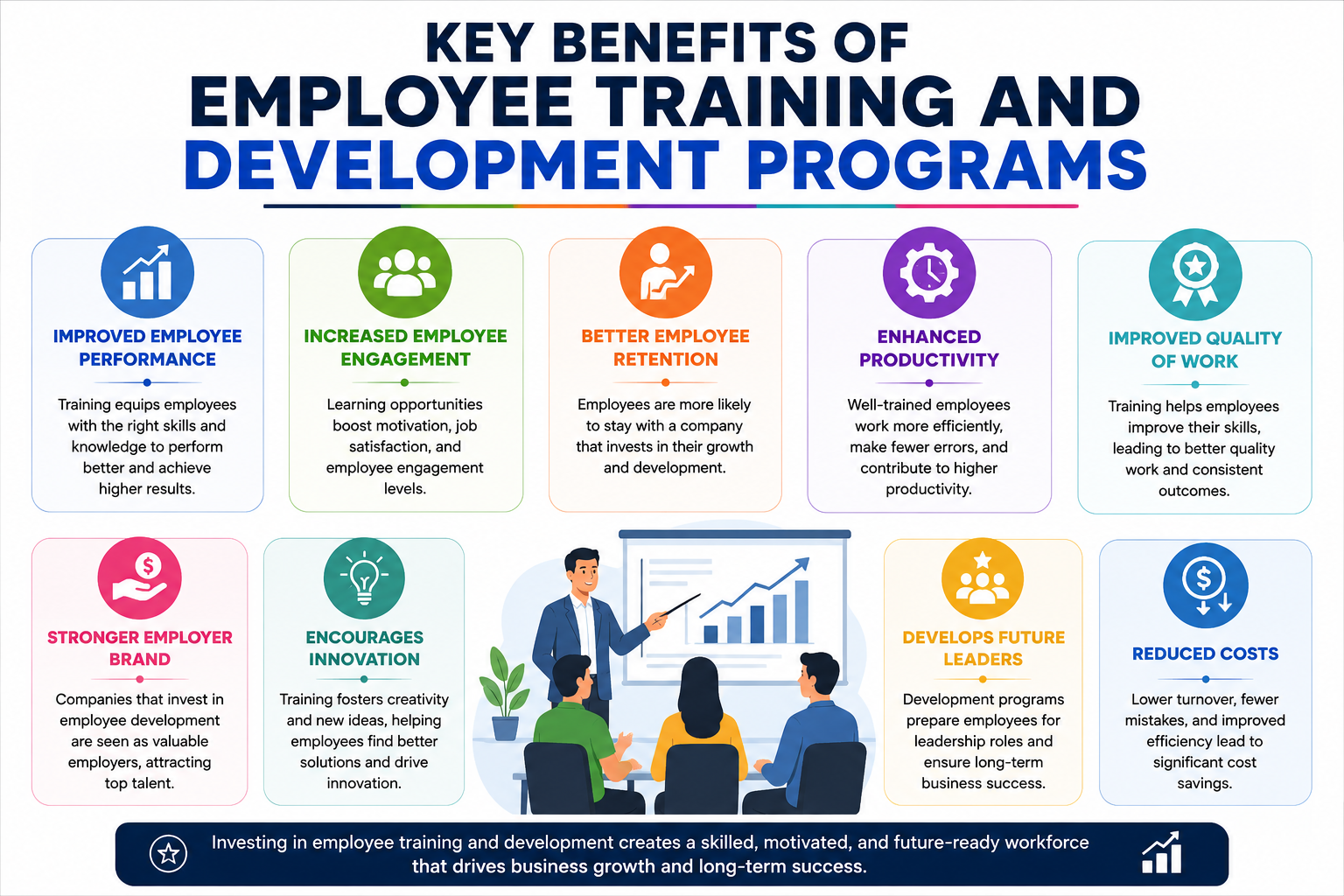
Organizations that invest in employee learning often experience significant advantages over competitors.
Improved Employee Performance
Employees perform better when they have the necessary knowledge and skills.
Effective employee training and development programs help employees:
- Understand job responsibilities
- Improve efficiency
- Reduce mistakes
- Increase productivity
- Meet performance expectations
When employees receive proper training, they become more confident in their abilities and contribute more effectively to organizational success.
Increased Employee Engagement
Employee engagement is closely linked to development opportunities.
Employees who feel supported in their professional growth are more likely to:
- Stay motivated
- Remain loyal
- Participate actively
- Contribute innovative ideas
Impact of Development on Engagement
| Development Opportunity | Engagement Level |
|---|---|
| No Training | Low |
| Occasional Training | Moderate |
| Continuous Learning | High |
| Career Development Plans | Very High |
Organizations that provide comprehensive employee training and development programs often experience higher levels of employee satisfaction and commitment.
Better Employee Retention
High employee turnover can be costly.
Replacing employees involves:
- Recruitment expenses
- Training costs
- Productivity losses
- Knowledge gaps
Training and development opportunities encourage employees to remain with organizations because they see opportunities for growth and advancement.
Retention Benefits
| Factor | Impact on Retention |
|---|---|
| Career Growth | High |
| Skill Development | High |
| Leadership Opportunities | High |
| Mentorship Programs | Medium-High |
| Recognition Programs | High |
Enhanced Organizational Productivity
Well-trained employees work more efficiently and require less supervision.
Benefits include:
- Faster task completion
- Improved quality
- Reduced errors
- Better teamwork
Organizations implementing employee training and development programs frequently report significant improvements in overall productivity.
Stronger Workplace Culture
Training promotes a culture of learning and collaboration.
Employees become more willing to:
- Share knowledge
- Support colleagues
- Embrace change
- Contribute ideas
A positive learning culture strengthens employee relationships and organizational performance.
Types of Employee Training and Development Programs
Modern organizations use various training approaches depending on business needs and workforce requirements.
Overview of Training Types
| Training Type | Primary Purpose |
|---|---|
| Onboarding Training | Employee integration |
| Technical Training | Skill enhancement |
| Soft Skills Training | Communication improvement |
| Leadership Development | Management growth |
| Compliance Training | Regulatory adherence |
| Product Training | Product expertise |
| Customer Service Training | Service excellence |
| Sales Training | Revenue growth |
| Digital Skills Training | Technology adoption |
| Cross-Training | Workforce flexibility |
Each type serves a unique purpose while contributing to employee growth and organizational success.
1. Onboarding Training Programs
Onboarding is often the first experience employees have with an organization.
Effective onboarding programs help employees:
- Understand company culture
- Learn workplace policies
- Clarify job expectations
- Build relationships
Components of Effective Onboarding
| Component | Purpose |
|---|---|
| Company Orientation | Organizational understanding |
| Policy Training | Compliance awareness |
| Role Introduction | Job clarity |
| Team Integration | Relationship building |
| Goal Setting | Performance expectations |
Organizations with strong onboarding-focused employee training and development programs often experience faster employee integration and improved retention.
2. Technical Skills Training Programs
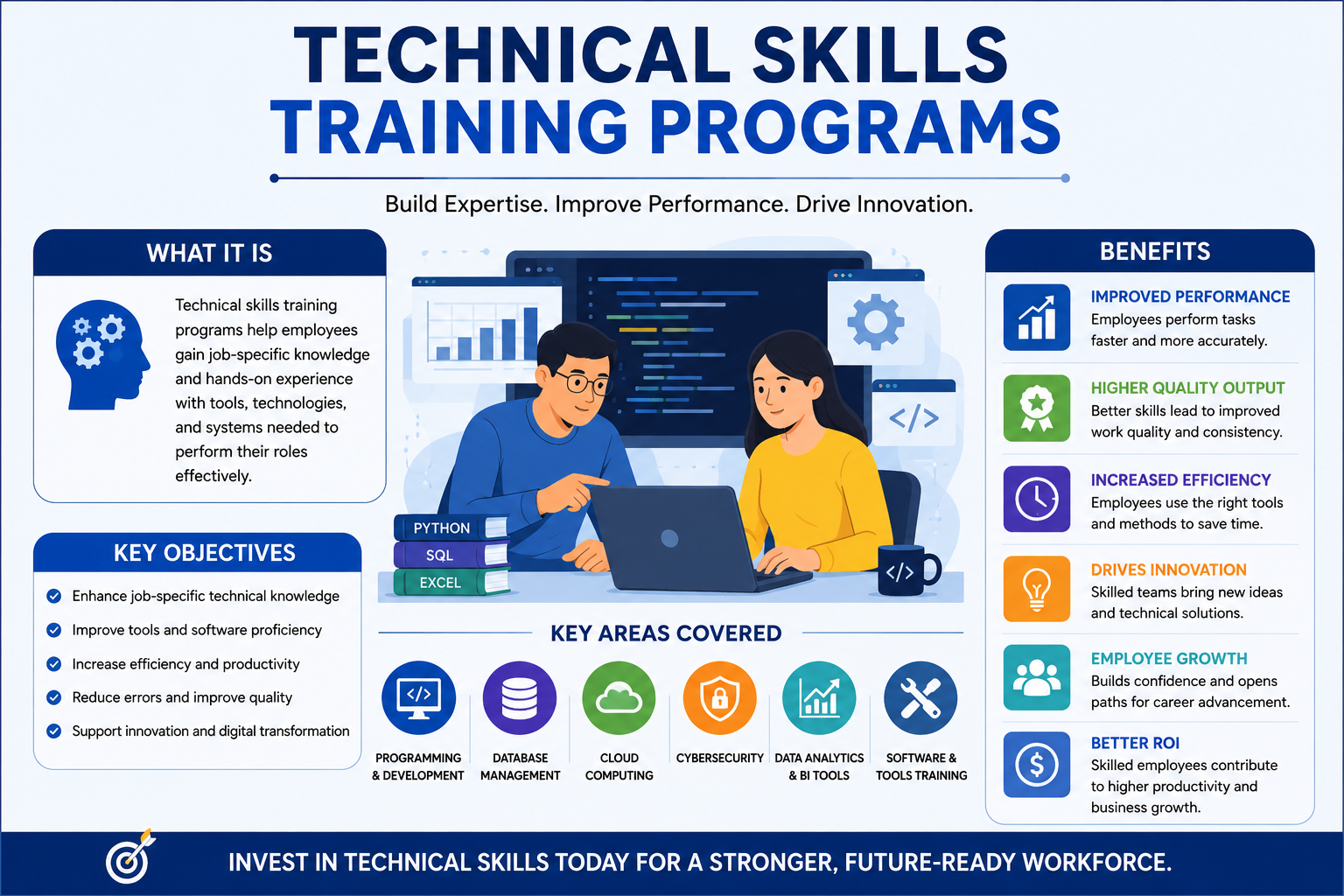
Technical skills training focuses on job-specific competencies required for performance.
Examples include:
- Software training
- Data analysis
- Engineering skills
- IT certifications
- Equipment operation
Benefits of Technical Training
| Benefit | Outcome |
|---|---|
| Improved Expertise | Better performance |
| Reduced Errors | Higher quality |
| Increased Efficiency | Greater productivity |
| Innovation | Better problem-solving |
As technology continues evolving, organizations must regularly update their technical training initiatives.
3. Soft Skills Development Programs
Technical expertise alone is no longer enough.
Employees also need strong interpersonal skills.
Essential Soft Skills
| Skill | Workplace Benefit |
|---|---|
| Communication | Better collaboration |
| Teamwork | Improved productivity |
| Problem-Solving | Faster solutions |
| Adaptability | Greater flexibility |
| Time Management | Higher efficiency |
Modern employee training and development programs increasingly emphasize soft skills because they directly impact workplace performance.
Communication Skills Training
Communication remains one of the most valuable workplace competencies.
Training may include:
- Active listening
- Presentation skills
- Business writing
- Conflict resolution
Employees who communicate effectively contribute to stronger teamwork and better business outcomes.
4. Leadership Development Programs
Leadership development is essential for building future organizational leaders.
Many organizations invest heavily in leadership-focused employee training and development programs to strengthen management capabilities and support succession planning.
Leadership Skills Developed
| Skill | Importance |
|---|---|
| Decision-Making | High |
| Strategic Thinking | High |
| Communication | High |
| Coaching | High |
| Emotional Intelligence | High |
Leadership training prepares employees for greater responsibilities and supports long-term organizational growth.
Emerging Leaders Programs
These programs target high-potential employees and future managers.
Participants learn:
- Leadership fundamentals
- Team management
- Performance coaching
- Conflict resolution
Developing internal leadership talent reduces recruitment costs and strengthens organizational stability.
5. Compliance Training Programs
Compliance training ensures employees understand legal, regulatory, and workplace requirements.
Common compliance areas include:
- Workplace safety
- Data privacy
- Anti-harassment policies
- Industry regulations
- Ethical standards
Compliance Training Benefits
| Benefit | Outcome |
|---|---|
| Risk Reduction | Fewer violations |
| Legal Protection | Reduced liability |
| Workplace Safety | Improved well-being |
| Ethical Culture | Better reputation |
Compliance-focused employee training and development programs help organizations maintain regulatory standards while protecting employees and business operations.
How Employee Training Impacts Business Growth
Employee development directly influences organizational performance.
Companies with strong learning cultures often achieve:
- Higher productivity
- Better customer satisfaction
- Increased innovation
- Stronger employee engagement
- Greater profitability
Business Impact of Training
| Area | Business Result |
|---|---|
| Employee Skills | Improved performance |
| Leadership Development | Better management |
| Innovation | Competitive advantage |
| Customer Service | Increased loyalty |
| Retention | Lower turnover costs |
Organizations that consistently invest in employee training and development programs create a workforce capable of adapting to changing market demands and supporting long-term business success.
Common Training Challenges Organizations Face
Despite the benefits, many organizations encounter obstacles when implementing training initiatives.
Common Challenges
| Challenge | Impact |
|---|---|
| Budget Constraints | Limited resources |
| Time Limitations | Reduced participation |
| Employee Resistance | Lower engagement |
| Skill Gaps | Training complexity |
| Measurement Difficulties | ROI uncertainty |
Effective planning and leadership support help overcome these challenges.
Best Practices for Successful Training Implementation
To maximize the value of employee training and development programs, organizations should follow proven best practices.
Training Success Checklist
| Practice | Benefit |
|---|---|
| Needs Assessment | Targeted learning |
| Clear Objectives | Better outcomes |
| Continuous Learning | Long-term growth |
| Leadership Support | Higher participation |
| Progress Tracking | Measurable results |
Organizations that implement these strategies often achieve stronger learning outcomes and improved business performance.
6. Product Knowledge Training Programs
Product knowledge training is one of the most valuable employee training and development programs for organizations that sell products or services. Employees who understand products thoroughly can communicate benefits more effectively, improve customer satisfaction, and increase sales performance.
Whether an organization operates in retail, manufacturing, technology, healthcare, or financial services, product knowledge directly impacts customer experience and business growth.
Key Objectives of Product Knowledge Training
| Objective | Benefit |
|---|---|
| Product Understanding | Better customer support |
| Feature Awareness | Increased sales confidence |
| Competitive Knowledge | Stronger market positioning |
| Problem Resolution | Improved customer satisfaction |
| Brand Representation | Enhanced credibility |
Employees who complete product-focused employee training and development programs are more capable of answering customer questions and recommending appropriate solutions.
Benefits of Product Knowledge Training
- Improved customer trust
- Higher conversion rates
- Better customer experiences
- Increased employee confidence
- Reduced customer complaints
7. Customer Service Training Programs
Customer service is often the defining factor that determines whether customers remain loyal to a business.
Organizations that prioritize customer service-focused employee training and development programs create stronger customer relationships and improve brand reputation.
Essential Customer Service Skills
| Skill | Importance |
|---|---|
| Active Listening | High |
| Communication | High |
| Empathy | High |
| Problem-Solving | High |
| Conflict Resolution | High |
Customer Service Training Components
Customer service training often includes:
- Customer communication techniques
- Complaint handling
- Service recovery strategies
- Relationship building
- Emotional intelligence
Why Customer Service Training Matters
Employees who interact directly with customers represent the organization.
Benefits include:
- Increased customer retention
- Better online reviews
- Higher customer satisfaction
- Improved brand image
Organizations with effective employee training and development programs focused on customer service often achieve significant competitive advantages.
8. Sales Training Programs
Sales performance directly impacts organizational revenue.
Sales-focused employee training and development programs help employees strengthen communication, persuasion, and negotiation skills.
Core Sales Competencies
| Competency | Business Impact |
|---|---|
| Prospecting | More opportunities |
| Communication | Better relationships |
| Negotiation | Increased revenue |
| Closing Techniques | Higher conversions |
| Customer Understanding | Better solutions |
Sales Training Topics
Employees often learn:
- Consultative selling
- Objection handling
- Relationship management
- Customer psychology
- Presentation skills
Benefits of Sales Training
Well-trained sales professionals typically:
- Generate more revenue
- Improve customer relationships
- Increase customer retention
- Strengthen organizational growth
Modern employee training and development programs frequently include digital sales techniques and virtual communication strategies.
9. Digital Skills Training Programs
Technology continues to transform workplaces across every industry.
Organizations must ensure employees possess the digital skills necessary for productivity and innovation.
Digital Skills Employees Need
| Skill | Purpose |
|---|---|
| Data Analysis | Better decisions |
| Software Proficiency | Increased efficiency |
| Cybersecurity Awareness | Risk reduction |
| Digital Communication | Improved collaboration |
| Automation Tools | Productivity improvement |
Importance of Digital Learning
Digital transformation requires employees to:
- Adapt quickly
- Learn new systems
- Improve technical proficiency
- Support innovation
Organizations that implement digital-focused employee training and development programs are better positioned to remain competitive.
Emerging Digital Skills
Training initiatives increasingly cover:
- Artificial Intelligence tools
- Cloud computing
- Data analytics
- Digital collaboration platforms
- Automation software
These capabilities help employees contribute more effectively in technology-driven environments.
10. Cross-Functional Training Programs
Cross-functional training develops employee capabilities beyond their primary responsibilities.
Employees learn skills from multiple departments, creating a more versatile workforce.
Benefits of Cross-Functional Training
| Benefit | Outcome |
|---|---|
| Workforce Flexibility | Improved operations |
| Knowledge Sharing | Better collaboration |
| Reduced Skill Gaps | Stronger productivity |
| Career Development | Higher engagement |
| Business Continuity | Greater resilience |
Why Cross-Training Matters
Organizations often face:
- Employee absences
- Skill shortages
- Increased workloads
- Changing business needs
Cross-functional employee training and development programs help address these challenges by creating a workforce capable of adapting to multiple responsibilities.
How to Choose the Right Employee Training and Development Programs
Selecting the right training initiative is critical for maximizing results.
Not all training programs deliver equal value. Organizations should evaluate workforce needs before investing in learning solutions.
Conduct a Training Needs Assessment
A needs assessment helps identify skill gaps and development priorities.
Assessment Areas
| Area | Purpose |
|---|---|
| Technical Skills | Performance improvement |
| Leadership Skills | Future leadership development |
| Communication Skills | Collaboration enhancement |
| Customer Service Skills | Customer satisfaction |
| Digital Skills | Technology adoption |
Training decisions should align with organizational goals and employee needs.
Align Training with Business Objectives
Effective employee training and development programs support organizational strategy.
Examples include:
- Improving productivity
- Increasing customer satisfaction
- Strengthening leadership pipelines
- Supporting digital transformation
- Enhancing employee engagement
Training should contribute directly to measurable business outcomes.
Consider Learning Preferences
Employees learn differently.
Organizations should offer multiple learning formats:
Popular Learning Methods
| Method | Advantage |
|---|---|
| Classroom Training | Interactive learning |
| Online Learning | Flexibility |
| Workshops | Practical application |
| Coaching | Personalized development |
| Mentoring | Long-term growth |
Blended learning approaches often produce the best results.
Best Practices for Successful Training Implementation
Training effectiveness depends on implementation quality.
Organizations should follow proven strategies to maximize learning outcomes.
Create Clear Learning Objectives
Every program should have measurable goals.
Examples include:
- Improve communication skills
- Increase leadership effectiveness
- Enhance customer service quality
- Develop technical expertise
Clear objectives improve accountability and performance measurement.
Secure Leadership Support
Executive involvement significantly influences training success.
Leadership Responsibilities
| Responsibility | Impact |
|---|---|
| Program Sponsorship | Increased participation |
| Resource Allocation | Better support |
| Communication | Higher engagement |
| Recognition | Stronger motivation |
Organizations with leadership-supported employee training and development programs typically achieve better outcomes.
Encourage Continuous Learning
Training should not be viewed as a one-time event.
Learning cultures encourage employees to continuously improve their skills.
Continuous Learning Approaches
- Microlearning
- Coaching
- Mentoring
- Peer learning
- Professional certifications
Organizations that support lifelong learning maintain stronger workforce capabilities.
Measuring the Success of Employee Training and Development Programs
Many organizations struggle to evaluate training effectiveness.
Measuring results helps determine whether learning initiatives deliver value.
Key Performance Indicators
Employee Productivity
Training should improve:
- Efficiency
- Output quality
- Task completion rates
Employee Engagement
Engaged employees are more likely to:
- Remain committed
- Perform better
- Contribute ideas
Employee Retention
Development opportunities significantly influence employee retention.
Training ROI Metrics
| Metric | Measurement |
|---|---|
| Productivity | Output improvement |
| Retention | Turnover reduction |
| Engagement | Survey scores |
| Customer Satisfaction | Customer feedback |
| Revenue Growth | Sales performance |
Organizations should regularly evaluate the effectiveness of employee training and development programs using objective performance indicators.
Future Trends in Employee Training and Development Programs
Workplace learning continues to evolve rapidly.
Organizations must adapt to emerging trends to remain competitive.
Artificial Intelligence in Learning
AI-powered learning platforms provide:
- Personalized recommendations
- Adaptive learning paths
- Real-time feedback
Benefits of AI Learning
| Benefit | Outcome |
|---|---|
| Personalization | Better engagement |
| Efficiency | Faster learning |
| Analytics | Improved tracking |
| Scalability | Wider access |
Mobile Learning
Employees increasingly prefer learning through mobile devices.
Benefits include:
- Anytime access
- Flexible learning
- Increased participation
Microlearning
Microlearning delivers information in short, focused modules.
Advantages include:
- Better retention
- Increased engagement
- Faster completion
Many modern employee training and development programs incorporate microlearning techniques.
Virtual Reality Training
VR-based learning provides immersive experiences that improve skill development and knowledge retention.
Applications include:
- Safety training
- Technical training
- Customer service simulations
Personalized Learning Experiences
Employees increasingly expect customized development opportunities.
Future learning programs will focus on:
- Individual skill gaps
- Career goals
- Performance objectives
Personalization improves both engagement and learning outcomes.
Frequently Asked Questions
What are employee training and development programs?
Employee training and development programs are structured learning initiatives designed to improve employee skills, knowledge, performance, and career growth.
Why are employee training and development programs important?
They help organizations improve productivity, employee engagement, retention, leadership development, and overall business performance.
What are the main types of employee training and development programs?
Common types include onboarding training, technical training, leadership development, compliance training, customer service training, sales training, digital skills training, and cross-functional training.
How do employee training and development programs improve productivity?
Training equips employees with the skills and knowledge needed to perform tasks efficiently, reduce errors, and improve overall performance.
How often should organizations provide employee training?
Training should be continuous and aligned with organizational goals, industry changes, and employee development needs.
What is the difference between training and development?
Training focuses on improving current job performance, while development prepares employees for future responsibilities and career advancement.
Conclusion
Investing in employee training and development programs is one of the most effective strategies organizations can use to improve workforce performance, increase employee engagement, and drive long-term business success. From onboarding and technical training to leadership development and digital skills enhancement, these programs equip employees with the knowledge and capabilities needed to excel in today’s rapidly changing workplace. Organizations that prioritize continuous learning create stronger teams, improve retention, foster innovation, and maintain a competitive advantage. By implementing well-structured employee training and development programs, businesses can build a skilled, adaptable, and future-ready workforce that supports sustainable growth and organizational excellence.
Contact Us
Looking to implement effective employee training and development programs ? Reach out to our team for customized solutions.
 Address:
Vivek Khand, Gomti Nagar, Lucknow, India
 Email:
 Phone:
- +91 99569 98880
- +91 94100 66699
 Website:
https://navigategrowth.in/
Instagram: https://www.instagram.com/thegrowthmindset.official/